Why Great Project Directors Listen More Than They Speak
The most successful construction leaders aren’t those with the loudest voices. They’re the ones who hear the problems before everyone else.
Walk into a project meeting halfway through a major construction programme and you’ll probably identify the project director within seconds. They are usually the person chairing the discussion, moving through the agenda and ultimately responsible for making the decisions that keep the project moving.
Ask people what makes someone effective in that role and the answers are often predictable. Experience. Confidence. Decisiveness. The ability to remain calm under pressure. Construction is, after all, an industry built around solving problems, and we naturally admire leaders who appear to have the answers.
Yet spend enough time observing the industry’s most respected project directors and a different pattern begins to emerge. They certainly make decisions, but they don’t rush to make them. They ask more questions than they answer. They invite disagreement instead of avoiding it. Most importantly, they spend far more time listening than speaking.
That may sound counterintuitive.
But on today’s construction projects, listening has become one of the most valuable technical skills a leader can possess.
Construction Has Outgrown the Hero Leader
For much of the twentieth century, construction projects were comparatively straightforward. Teams were smaller, communication lines were shorter and projects relied heavily on the experience of a handful of senior professionals. A good project manager often knew every consultant, every subcontractor and every major decision being made on site.
That world no longer exists.
Modern construction projects are ecosystems of specialists. A large hospital may involve hundreds of consultants. A transport project can require thousands of subcontractors working across dozens of contracts. Digital engineering, BIM coordination, sustainability requirements, procurement strategies, planning authorities, health and safety legislation and stakeholder engagement all compete for attention before a single brick is laid.
No individual can master every discipline.
The role of the project director has therefore evolved. Leadership is no longer about knowing everything. It is about bringing together people who collectively do.
The best leaders understand that expertise is spread across the entire project team.
Most Problems Announce Themselves Before They Become Expensive
Construction problems rarely appear without warning.
Programme delays usually begin as small coordination issues. Cost overruns often start with unanswered design queries. Disputes frequently grow from conversations that never happened or concerns that were dismissed too quickly.
Experienced project directors understand this instinctively. They know that every project produces hundreds of small signals long before those signals develop into major issues. Their job is to recognise which ones deserve attention.
That is why successful leaders spend time walking the site rather than remaining behind a desk. They ask supervisors what is worrying them. They challenge optimistic programme updates. They invite subcontractors to raise issues before they become claims. They understand that preventing a problem is almost always less expensive than solving one.
Listening allows those early warnings to surface.
Ignoring them allows them to grow.
How Poor Communication Becomes a Cost Overrun
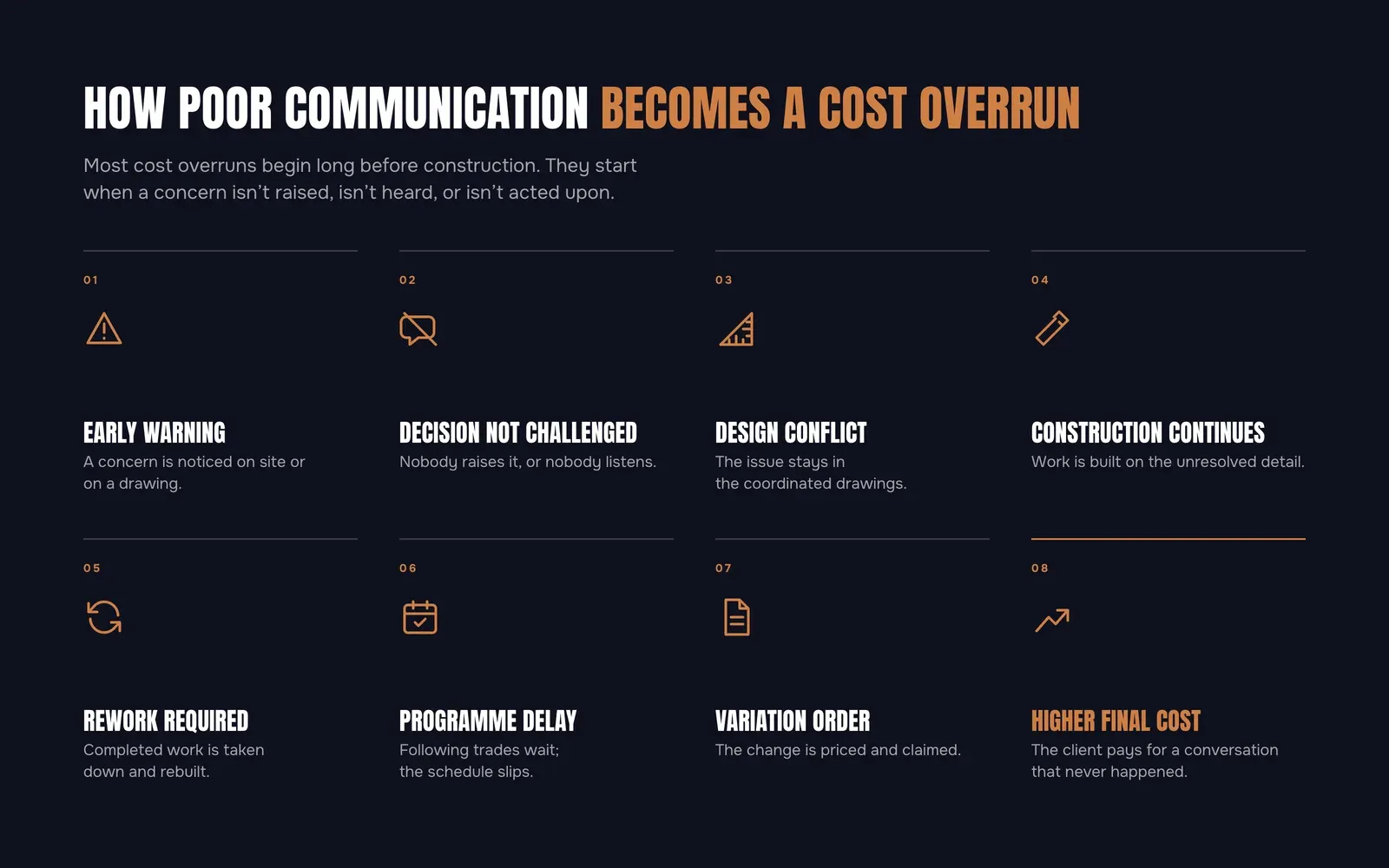
Early Warning → Decision Not Challenged → Design Conflict → Construction Continues → Rework Required → Programme Delay → Variation Order → Higher Final Cost
Key Insight: Most cost overruns begin long before construction. They start when a concern isn’t raised, isn’t heard, or isn’t acted upon.
History Is Full of Warnings That Went Unheard
Some of history’s greatest engineering failures were not caused by technical incompetence. The knowledge needed to prevent them already existed.
The Space Shuttle Challenger disaster remains one of the most powerful examples. Engineers had expressed concerns about the performance of the O-ring seals in freezing temperatures before launch. Those concerns were discussed, questioned and ultimately overridden. The subsequent investigation concluded that the failure was not simply technical. It was organisational. Critical information never carried enough weight in the final decision.
Construction projects obviously operate on a different scale, but the lesson is remarkably similar.
Almost every experienced contractor can remember a project where someone noticed the problem first. A graduate engineer questioned a detail on a drawing. A site manager raised concerns about sequencing. A subcontractor highlighted an access issue before installation began.
The warning existed.
The challenge was ensuring somebody listened.
The most expensive mistake is often the one somebody tried to prevent.
Listening Is Risk Management
Many organisations still think of communication as a soft skill. In reality, it is one of the most effective forms of risk management available.
Google reached a remarkably similar conclusion when it conducted Project Aristotle, a multi-year study analysing more than 180 teams to understand why some consistently outperformed others. Researchers expected to find that successful teams had the smartest people or the strongest leaders.
Instead, they found something different.
The single strongest predictor of performance was psychological safety—an environment where people felt comfortable admitting uncertainty, asking questions and challenging ideas without fear of embarrassment.
Construction projects are no different. When people believe they will be criticised for raising concerns, they remain silent. Risks stay hidden until they appear as programme delays, rework or contractual disputes. By contrast, teams that encourage open discussion identify issues earlier, resolve them faster and spend less time dealing with the consequences.
Listening is not simply about creating a positive working environment.
It protects projects.
Crossrail Demonstrated That Communication Is Infrastructure
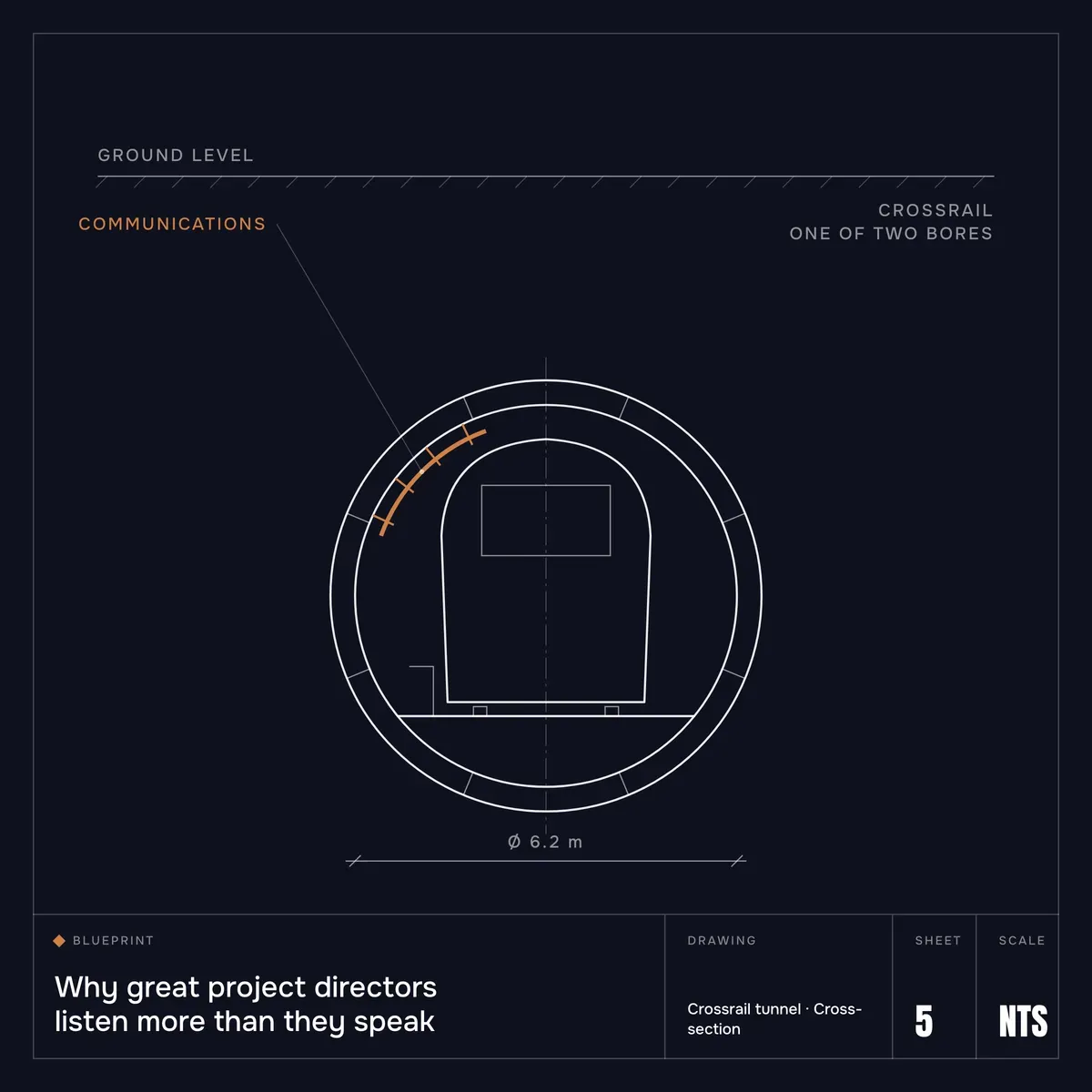
When Crossrail—now the Elizabeth line—was under construction, it became one of Europe’s largest infrastructure projects. More than forty major contracts, thousands of organisations and tens of thousands of workers were involved over the life of the programme.
The engineering challenges were immense, but so were the communication challenges.
Every interface between contractors represented an opportunity for misunderstanding. Every design revision had the potential to affect multiple packages simultaneously. Decisions made in one part of the programme often influenced work taking place kilometres away.
Managing that complexity required far more than technical excellence.
It required information to flow freely between disciplines, organisations and leadership teams. Crossrail demonstrated that on projects of this scale, communication is not an administrative function. It is part of the engineering itself.
Where Great Leaders Spend Their Time
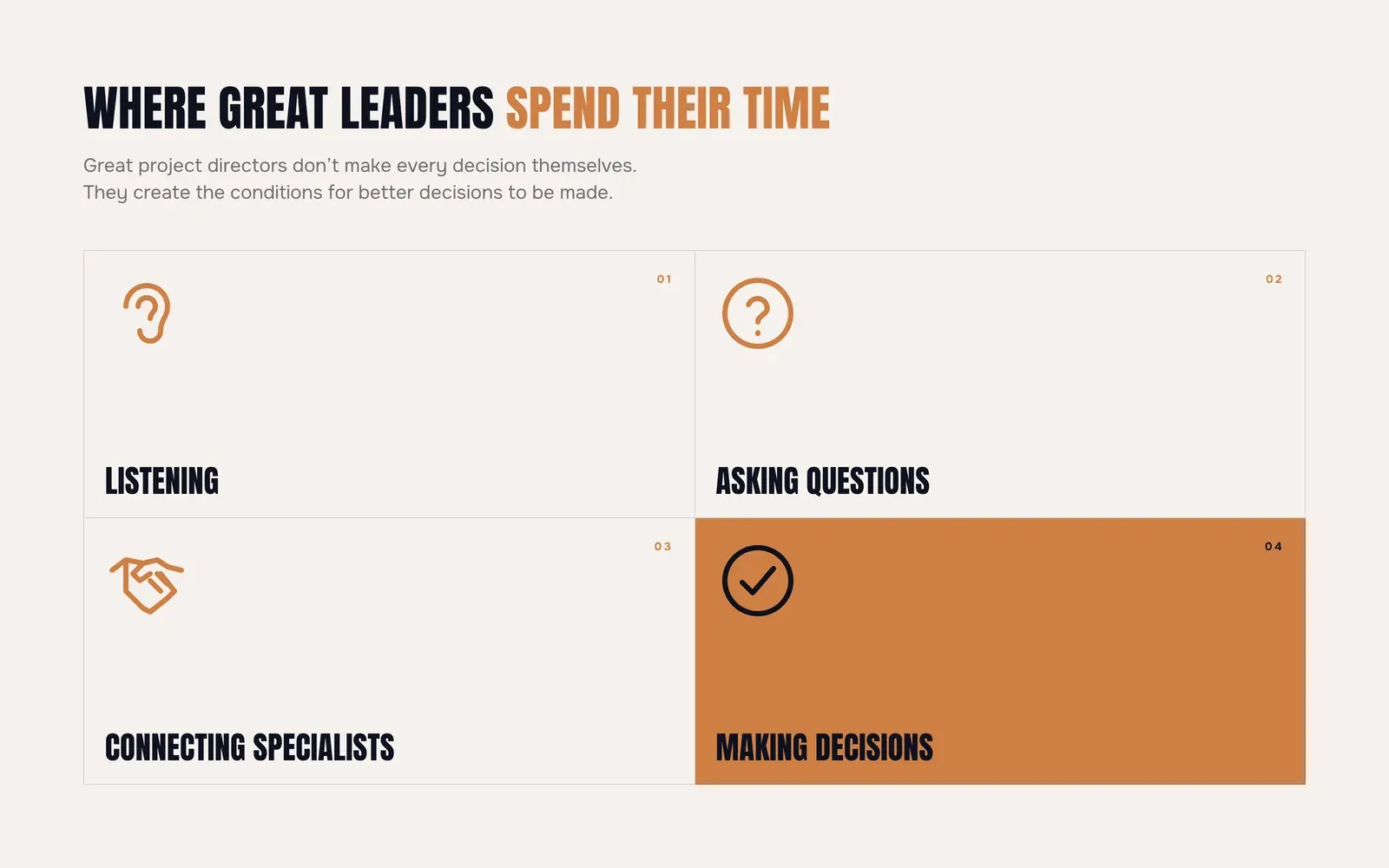
Listening · Asking Questions · Connecting Specialists · Making Decisions
Great project directors don’t make every decision themselves. They create the conditions for better decisions to be made.
Better Decisions Come From Better Conversations
There is a persistent myth that decisive leaders make decisions quickly and independently. Experienced project directors understand the opposite is usually true.
A structural engineer may identify a technical constraint that affects the programme. A quantity surveyor may recognise a commercial risk hidden within the specification. The planner understands sequencing. The site manager sees practical issues that are invisible on a drawing. None of these perspectives are complete on their own, but together they create a far clearer understanding of the project.
Listening allows those perspectives to meet before decisions are made.
That is why the best project meetings rarely feel like presentations. They feel like discussions. People challenge assumptions, explore alternatives and test ideas before agreeing on a way forward. Those conversations may take longer, but they often save months during construction.
Leadership Is Measured Before the Crisis
Anyone can lead once a problem becomes obvious.
The real test is recognising the issue while it is still small enough to solve.
Successful project directors develop habits that make this possible. They walk the site. They ask questions that have no immediate agenda. They encourage junior team members to contribute. They pay attention to quiet voices because they know those voices are often closest to the work.
Trust is built through these everyday conversations.
And trust encourages honesty.
The Leadership Pyramid
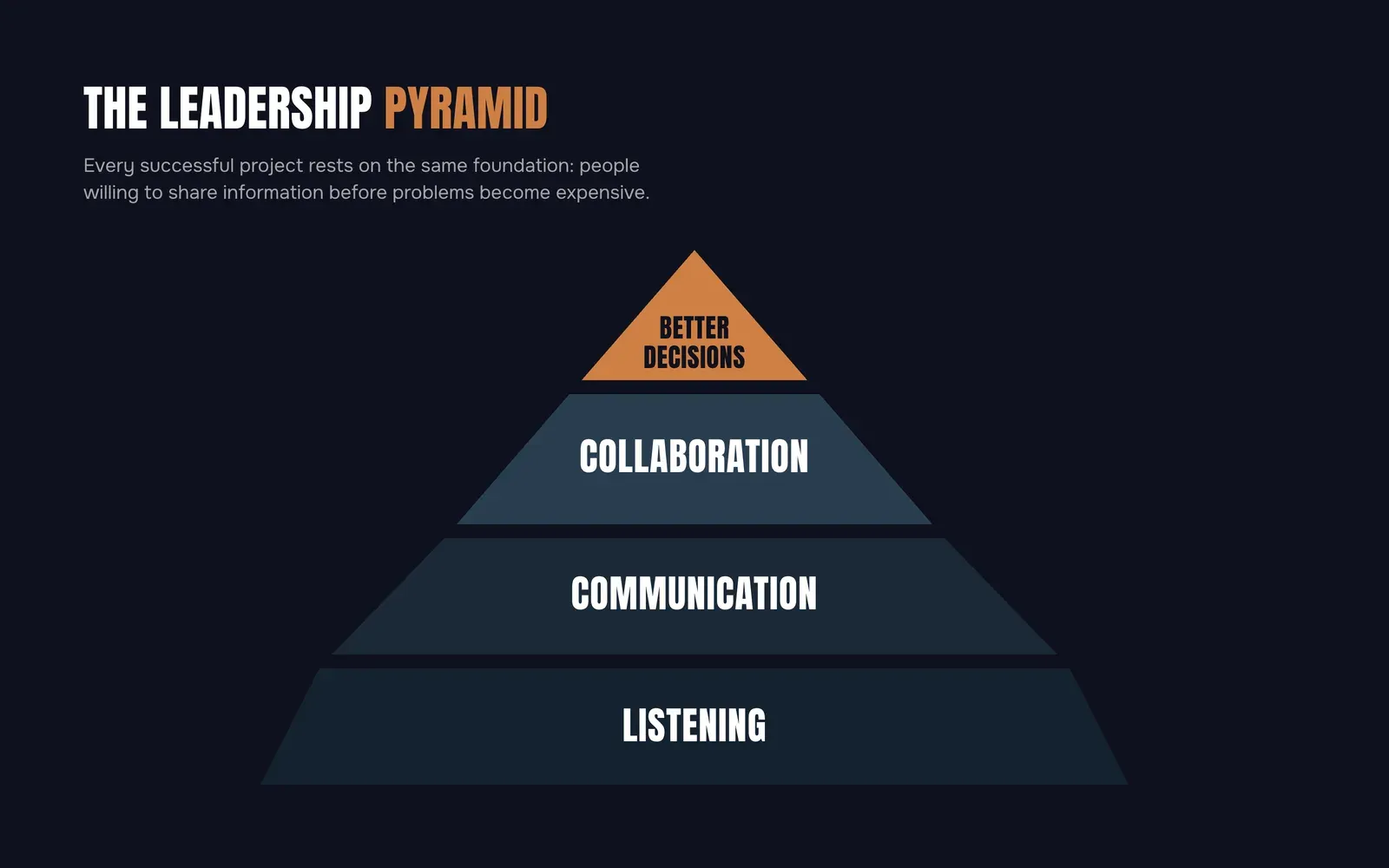
Listening → Communication → Collaboration → Better Decisions
Every successful project rests on the same foundation: people willing to share information before problems become expensive.
Leadership Begins With Listening
Construction will only become more complex. Artificial intelligence, digital twins, modern methods of construction, increasingly demanding environmental standards and more sophisticated procurement strategies will continue reshaping the industry over the coming decades.
No project director will ever know everything.
The leaders who succeed will be those who recognise that they do not have to.
They will ask better questions. They will encourage disagreement before agreement. They will create environments where information moves freely between disciplines instead of becoming trapped within them. Most importantly, they will understand that leadership is not demonstrated by speaking first.
It is demonstrated by making sure the right people are heard.
Because in construction, the difference between a successful project and an expensive lesson is often nothing more than one conversation that happened early enough to change the outcome.
Sources
- Amy C. Edmondson – The Fearless Organization (Harvard Business School Press)
- NASA – Report of the Presidential Commission on the Space Shuttle Challenger Accident
https://history.nasa.gov/rogersrepgen.htm 3. Project Management Institute (PMI) – Pulse of the Profession
https://www.pmi.org 4. Bent Flyvbjerg & Dan Gardner – How Big Things Get Done (2023) 5. Crossrail Learning Legacy – Programme reports and lessons learned
https://learninglegacy.crossrail.co.uk 6. Construction Industry Institute (CII) – Research on team alignment and project performance