When Buildings Were Expected to Outlive Their Builders
Malta’s master builders created buildings meant to serve those who inherit them. What can modern construction learn from that long view?
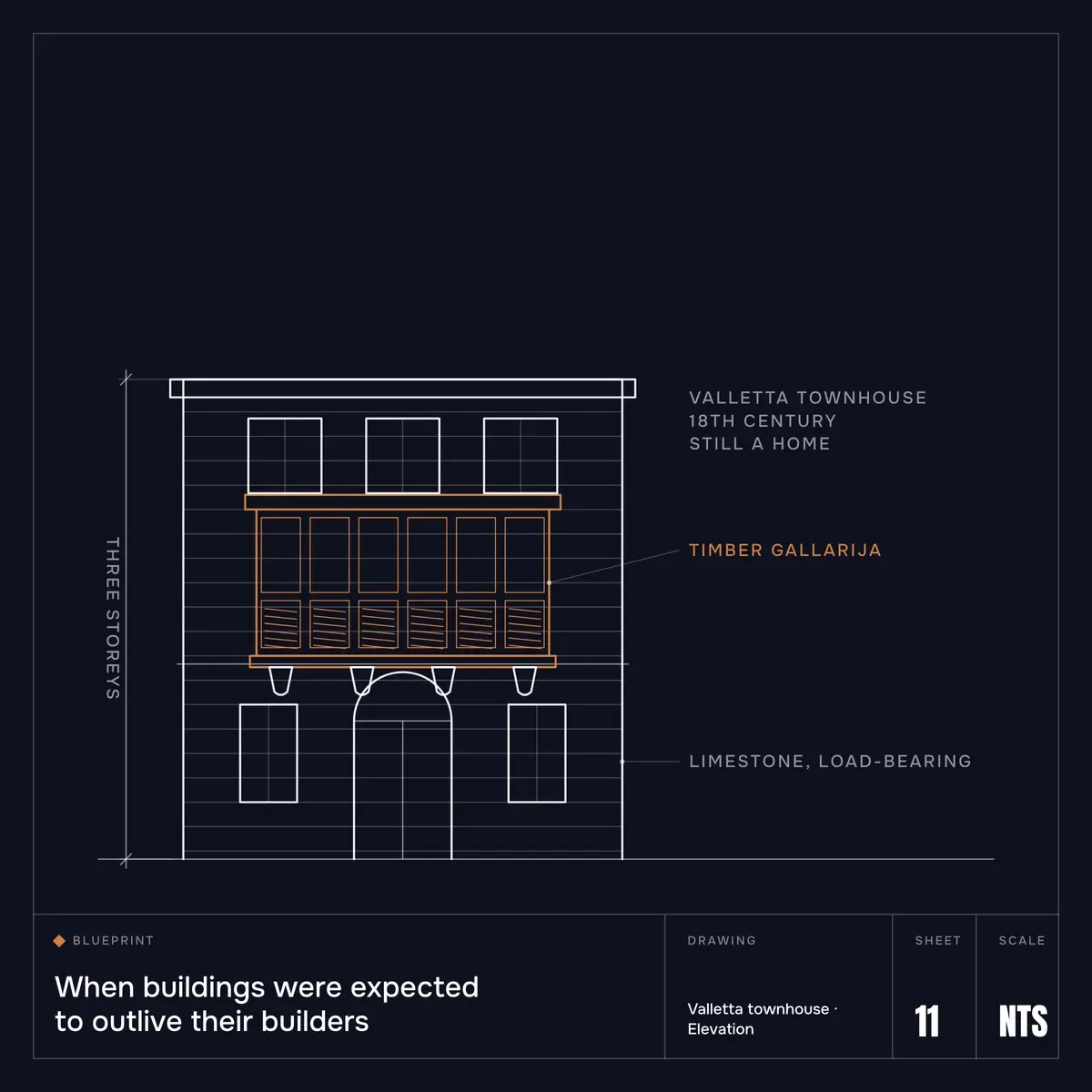
A Building Older Than Entire Nations
An old building earns its place in a city through the life it continues to support. A restored facade may attract attention, but the homes, workplaces and public spaces behind it are what keep the building relevant.
Valletta offers a clear example. Founded in 1566, the city retains much of its historic urban form while continuing to function as Malta’s administrative and commercial centre. UNESCO describes both the preservation of its historic fabric and the pressures that come with being a living city. Its value depends on managing those two realities together. ++[1]++
The buildings we inherit invite us to consider a longer timescale for the buildings we commission today. Handover is an important milestone. It is also the point at which years of occupation, maintenance and change begin.
Survival takes work
It is tempting to look at a centuries-old building and assume that earlier generations always built better. That conclusion overlooks the buildings that have disappeared, as well as the repairs and investment that have kept the survivors standing.
UNESCO records the rebuilding and restoration that followed damage to Valletta, including during the Second World War. The city we see today has been cared for and changed over time. It is not an untouched record of its first construction. ++[1]++
This distinction matters for modern owners. Durability does not remove the need for inspection, repairs or replacement of worn components. A building can have a long useful life while its roof coverings, windows, finishes and services are renewed at different intervals.
Good stewardship begins with knowing what needs attention. An unresolved leak, an inaccessible service connection or a repair made without understanding the existing construction can undermine an otherwise valuable asset. The maintenance strategy deserves a place in the project brief from the start.
A new use can protect an old building
MUŻA, Malta’s National Community Art Museum, occupies the Auberge d’Italie in Valletta. Heritage Malta records that the museum opened there in 2018. The project gives a historic building a contemporary public role while keeping it part of the city’s cultural life. ++[2]++
That example does not mean every historic property can accommodate any new use. A proposed conversion must work with the building’s structure, significance, access and condition. Some interventions are straightforward; others would damage the qualities that make the property worth retaining.
The useful question is specific: which new use can this building support well, and what work would make that possible? Answering it calls for surveys and collaboration between the owner, designers, conservation specialists and construction team.
A Different Philosophy of Building
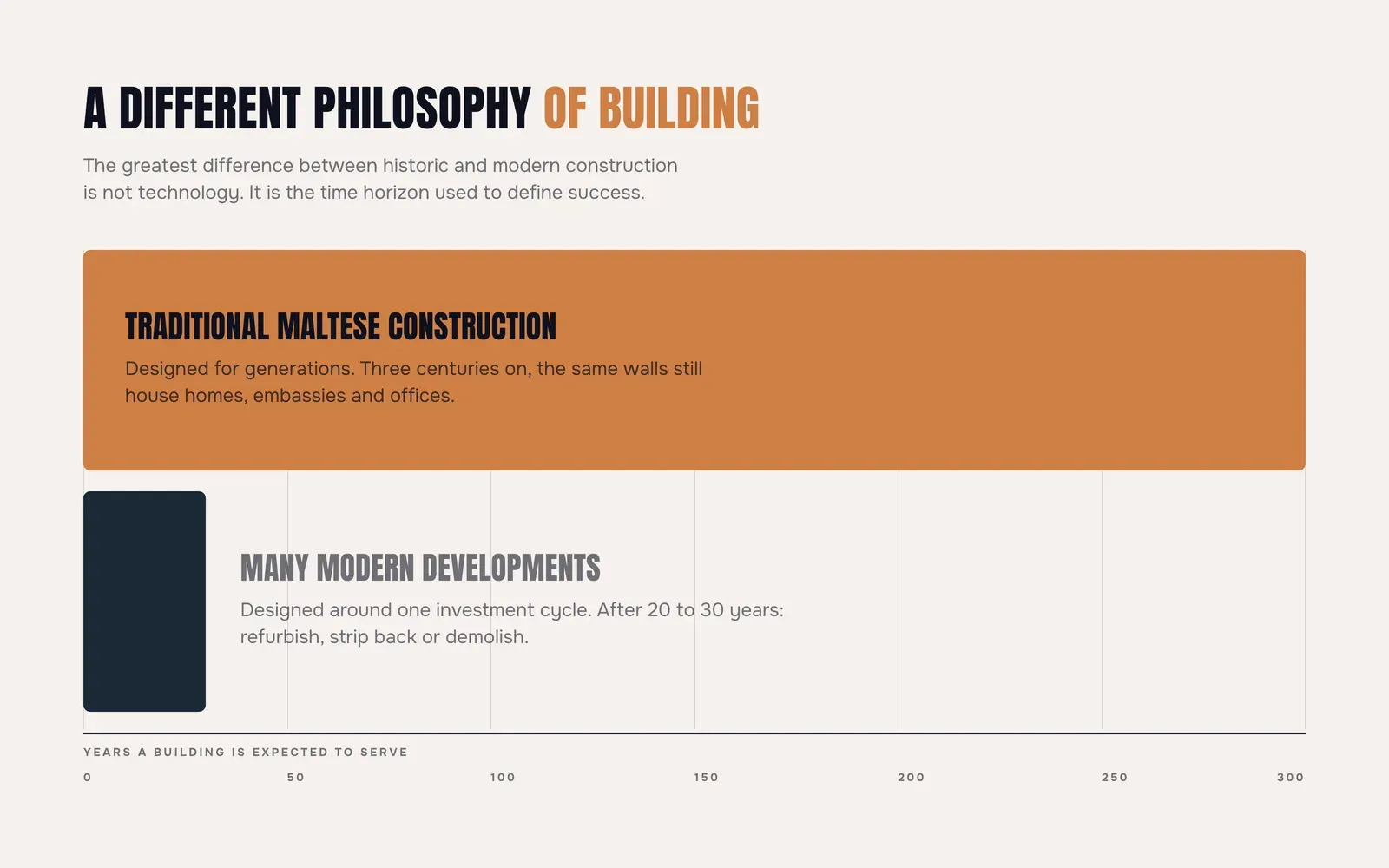
A conceptual comparison of investment horizons. Historic survival reflects maintenance and adaptation; modern buildings do not have a universal lifespan of 20 to 30 years.
Conclusion — Building for People We Will Never Meet
Long-term thinking is a practical discipline. It asks an owner to consider who will maintain the property, how essential equipment can be replaced and whether a future occupier could use the space without excessive reconstruction.
For a new building, those questions can influence service access, layouts and material choices. For an existing property, they can guide which features to retain and which interventions will make continued use viable. The appropriate answer will differ from one building to another.
Building for future owners
The next owner will need more than an attractive building. They will need clear records, access to maintain it and a structure whose condition can be understood. Decisions that simplify that work can preserve value long after the original team has moved on.
Malta’s historic buildings make this responsibility visible. Their continued use reflects contributions from many generations, including people who repaired, adapted and invested in them. New projects can support the same continuity by treating future maintenance and change as part of the design brief.
That is a useful ambition for construction today: to hand over a building that works now and gives its next custodians good options.