The Tender Is Only the Beginning
Why procurement decisions shape everything that follows.
Ask almost anyone outside the construction industry when the most important decision on a project is made, and they will probably point to the day the contract is awarded.
The client has chosen a contractor.
The paperwork has been signed.
The price has been agreed.
Surely the difficult part is over.
In reality, experienced project teams often see that moment very differently.
Winning a tender is not the end of a project; it is the beginning of one. More importantly, the way a contractor is selected often determines how smoothly the project will be delivered long before the first excavator arrives on site.
Procurement is often treated as a commercial exercise focused on comparing prices. In reality, it is one of the most influential engineering decisions a client will ever make. The contractor, procurement strategy, contract type, allocation of risk and quality of tender information all shape what happens during construction. When those decisions are made well, projects tend to move with confidence. When they are made poorly, even the most experienced teams can spend months recovering from problems that were built into the project from the very beginning.
The irony is that procurement is usually one of the least visible stages of construction. Clients remember the cranes, the concrete and the completed building. Few remember the weeks spent evaluating tenders, reviewing drawings and negotiating contracts. Yet those quiet meetings often have more influence on the final outcome than anything else that happens on site.
The Lowest Price Is Easy to Compare
Price is attractive because it provides a seemingly objective and easily comparable basis for evaluating value.
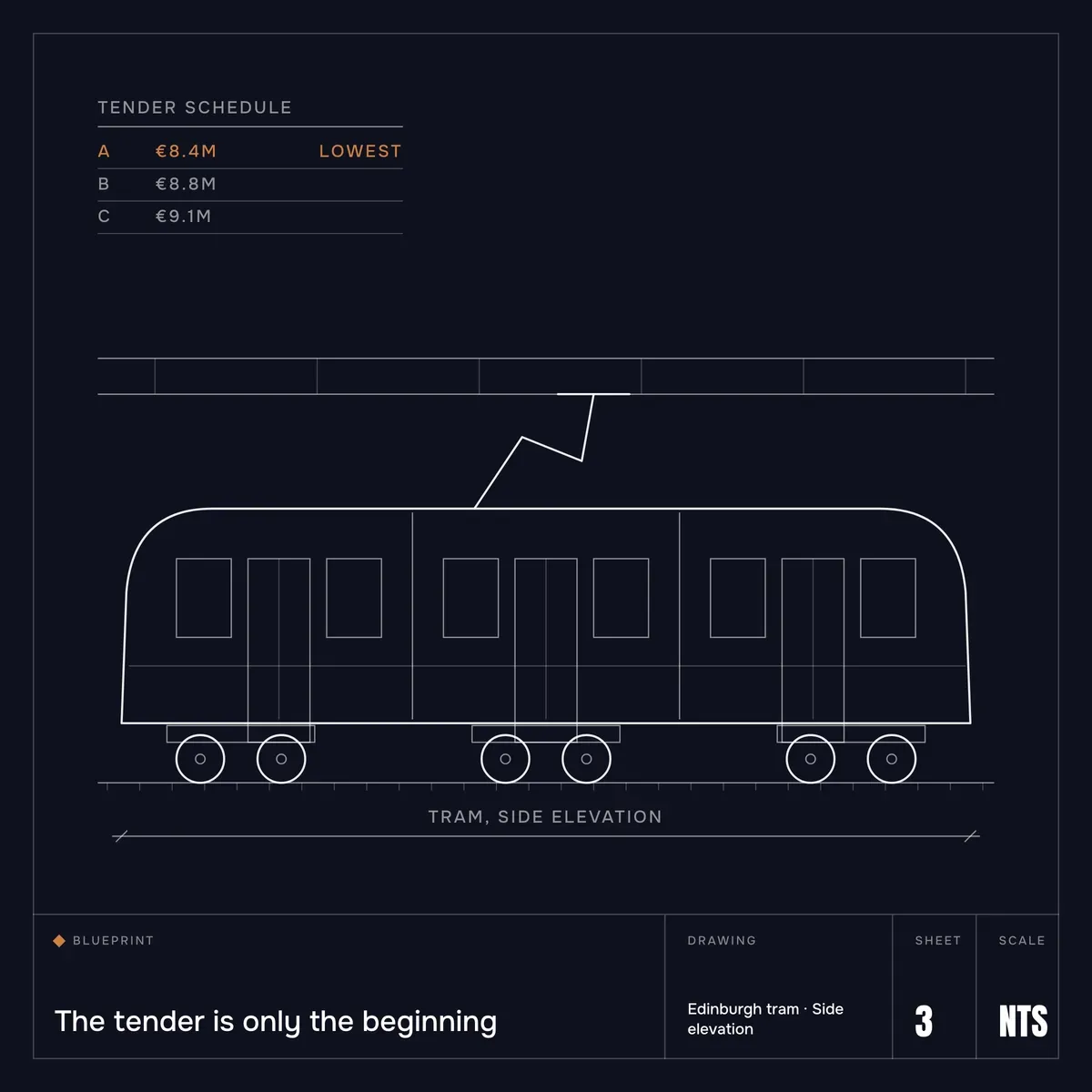
One contractor submits €8.4 million.
Another submits €8.8 million.
A third submits €9.1 million.
The decision seems straightforward.
The spreadsheet has a winner.
Unfortunately, buildings are not delivered inside spreadsheets.
A tender tells you what a contractor believes they can deliver based on the information available at that moment. It cannot fully measure the experience of the site team, the quality of communication, the realism of the construction programme, the strength of subcontractor relationships or the contractor’s ability to solve unexpected problems.
These are often the factors that determine whether a project finishes smoothly or becomes a constant battle.
This is one of the reasons why procurement professionals increasingly talk about best value rather than lowest cost. A slightly higher tender can ultimately produce a lower final project cost if it reduces delays, avoids claims, improves coordination and delivers a higher quality result.
The World Bank, which procures billions of euros of infrastructure projects every year, has gradually moved towards a value-based procurement approach rather than relying solely on the lowest bid. Their guidance recognises that quality, capability, innovation and long-term performance often provide better outcomes than selecting contractors based purely on price.
The Tender Only Measures What Can Be Written Down
There is another limitation that is rarely discussed.
Tender documents can describe drawings.
They can describe specifications.
They can describe quantities.
What they cannot easily describe is judgement.
They cannot measure how a project manager responds when unexpected ground conditions appear.
They cannot score the relationship between a contractor and its subcontractors.
They cannot predict how quickly design issues will be resolved during construction.
They cannot estimate the value of twenty years of experience sitting around a meeting table.
Construction remains a business built on people.
Two contractors may submit almost identical prices while delivering completely different projects because the quality of leadership, planning and communication behind those numbers is impossible to capture inside a tender document.
That is why experienced clients rarely evaluate tenders by looking only at the final page.
They spend far more time reading everything that comes before it.
When Procurement Creates Problems
The construction industry has no shortage of examples where procurement decisions shaped the entire life of a project.
One of the most widely discussed is the Edinburgh Trams project.
Delivered through a complex contractual structure involving multiple organisations and interfaces, the project experienced years of disputes over scope, responsibility and change. Independent reviews concluded that governance, procurement strategy and contract management contributed significantly to the difficulties experienced during delivery.
The engineering itself was never the greatest challenge.
Managing the relationships created by procurement became the challenge.
Crossrail offers a different lesson.
Rather than relying on a single contractor, the programme was divided into numerous specialist packages. This allowed expertise to be brought into different parts of the project, but it also created an enormous coordination challenge. Success depended not only on individual contractors performing well, but on how effectively those separate factions worked together.
Procurement decisions made years earlier influenced every stage of construction.
The lesson is simple.
Procurement is not administration.
It is project design.
The Cheapest Project Is Rarely the Cheapest Tender
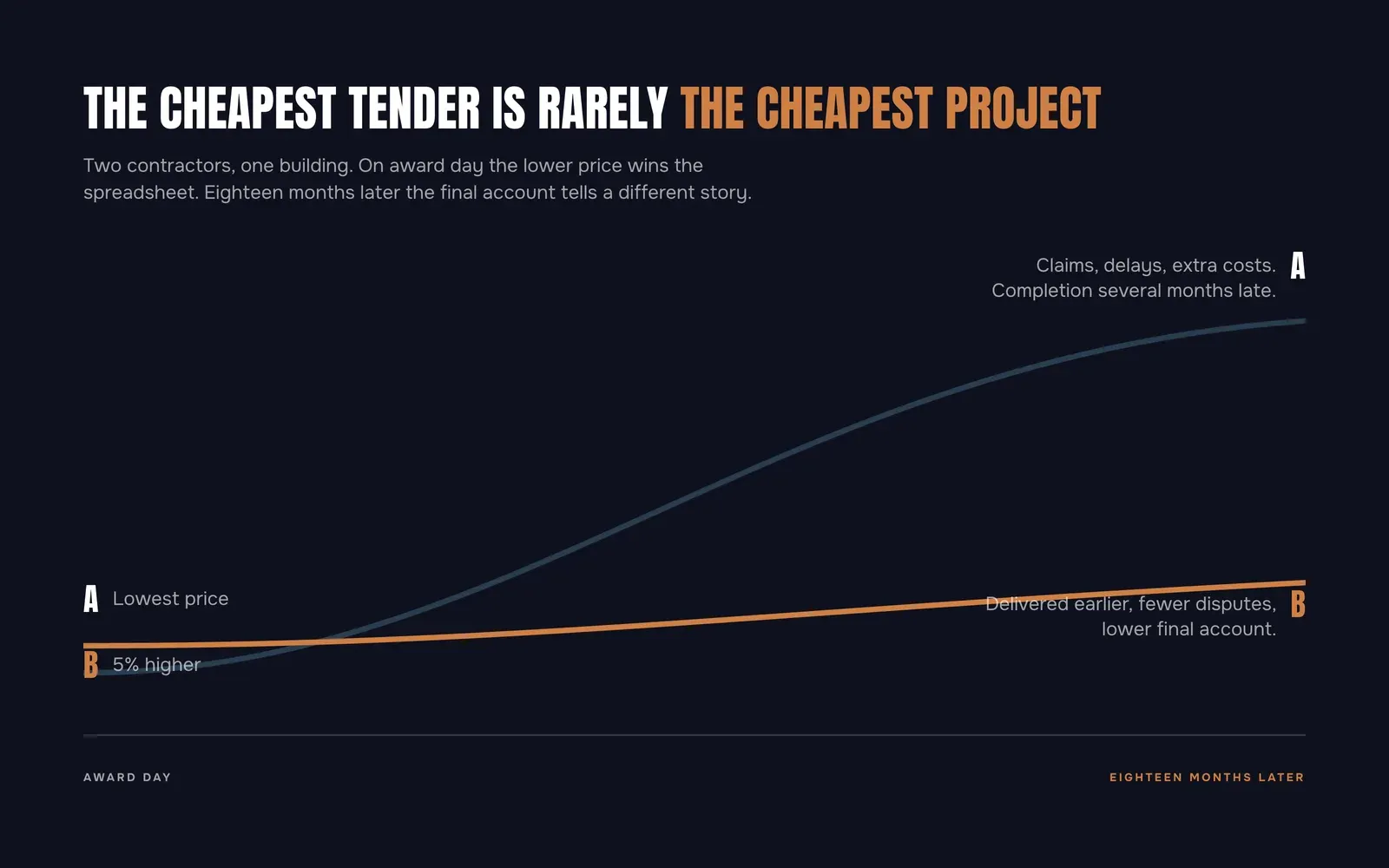
Imagine two contractors bidding for the same project.
The first submits the lowest price but allows very little contingency for unexpected issues. The second costs 5% more but has invested more time in planning, coordination and risk management.
On award day, the first contractor appears to offer better value.
Eighteen months later, the picture may look very different.
Design changes generate claims.
Delays extend preliminaries.
Subcontractors submit additional costs.
Completion moves back by several months.
Meanwhile, the second contractor may have delivered the same building earlier, with fewer disputes and a lower final account.
The cheapest tender and the cheapest project are not always the same thing.
That distinction is one of the most expensive lessons many clients learn.
Procurement Is Really About Risk
Every construction project contains uncertainty.
Ground conditions.
Weather.
Supply chains.
Design coordination.
Planning approvals.
Nobody can eliminate these risks completely.
Procurement simply decides who carries them and how they will be managed.
When risks are allocated fairly, projects tend to encourage collaboration.
When risks are transferred unrealistically, they often return later as claims, disputes or programme delays.
This is one of the reasons organisations such as FIDIC, whose contract forms are used on major international infrastructure projects, place such importance on balanced contracts and clearly defined responsibilities. Good procurement is not about shifting every possible risk onto someone else. It is about allocating risk to the party best able to manage it.
That principle has remained remarkably consistent across decades of international construction.
The Best Procurement Decisions Are Invisible
The best procurement process rarely becomes a case study.
Nobody writes headlines about projects that finished on time because the right contractor was selected.
Nobody celebrates the meeting where risks were identified before they became expensive.
Nobody remembers the tender evaluation that prevented years of contractual disputes.
Good procurement is almost invisible.
Its success is measured by the absence of problems rather than the presence of dramatic solutions.
Like good engineering, it often goes unnoticed precisely because it worked.
The Tender Is Only the Beginning
Construction projects are often judged by what happens on site.
In reality, many of their greatest successes—or failures—are decided long before construction begins.
The tender is not simply a competition between contractors.
It is the moment when clients choose how risk will be managed, how teams will work together and how problems are likely to be solved over the months and years ahead.
That decision deserves far more attention than the final price alone.
Because the cheapest number on a spreadsheet may win the tender.
But it does not always deliver the best project.
Sources
- World Bank – Procurement Framework and Value for Money
https://www.worldbank.org/en/projects-operations/products-and-services/brief/procurement-new-framework 2. FIDIC – Procurement and Contract Guidance
https://fidic.org 3. UK National Audit Office – Completing Crossrail
https://www.nao.org.uk/reports/completing-crossrail/ 4. Edinburgh Tram Inquiry – Final Report
https://www.edinburghtraminquiry.org/ 5. Chartered Institute of Procurement & Supply (CIPS) – Best Value Procurement Guidance