The Cost of Changing Your Mind During Construction
Why the smallest decision can become the most expensive one on a project.
If you ask someone outside the construction industry what makes projects expensive, the answers are usually predictable.
Steel prices
Labour shortages
Bad weather
Inflation
While all of these do have an impact, they are rarely the biggest reason projects go over budget.
One of the most expensive events on any construction project is surprisingly ordinary: changing your mind.
A different floor finish. Moving a wall by half a metre. Relocating electrical outlets. Choosing another facade system. Individually, these decisions may seem small. Yet, once construction has begun, they create a chain reaction that reaches far beyond the item being changed.
In construction, the cost of a change is rarely the cost of the change itself. It is the cost of everything the change affects.
Every Change Creates a Ripple
Imagine a client decides to move a staircase after the concrete structure has already been completed.
At first glance, it sounds like a straightforward design revision. In reality, that single decision can trigger structural redesign, updated architectural drawings, revised mechanical and electrical layouts, new fire strategy approvals, additional engineering reviews, demolition of completed work, new procurement orders and delays to every trade waiting to continue.
One decision becomes twenty.
One drawing becomes fifty.
One week quickly becomes a month.
The Construction Industry Institute (CII), one of the world’s leading construction research organisations, has spent decades studying the impact of project changes. Its research concludes that changes affect far more than the work being altered. They reduce labour productivity, disrupt sequencing, increase management time and create a ripple effect across the entire project.
This is why experienced project teams often spend hours discussing what appears to be a minor design decision. They are not debating today’s task. They are trying to avoid tomorrow’s consequences.
The Most Expensive Part Is the Work You Don’t See
Clients often expect to pay for the physical work involved in a change.
What they don’t see is everything that happens behind the scenes.
An engineer redesigns structural elements.
The architect updates coordinated drawings.
Procurement teams cancel or reorder materials.
Site managers reorganise the programme.
Subcontractors reschedule labour.
Completed work may need to be removed before new work can even begin.
Research from the Construction Industry Institute found that every change introduces hidden costs through lost productivity, supervision, disruption and additional project management—not just the direct cost of replacing materials or labour. When several changes occur together, those effects multiply rather than simply add together.
This explains why two projects with identical budgets can finish with completely different final costs. One follows a clear plan. The other constantly changes direction.
A Lesson from the Sydney Opera House
Few buildings are more recognisable than the Sydney Opera House.
It is also one of the most famous examples of how changing decisions can reshape an entire project.
Construction began in 1959 before the iconic roof structure had been fully engineered. As engineers continued searching for a practical solution, significant parts of the design evolved during construction. Internal layouts were also revised, requiring further redesign.
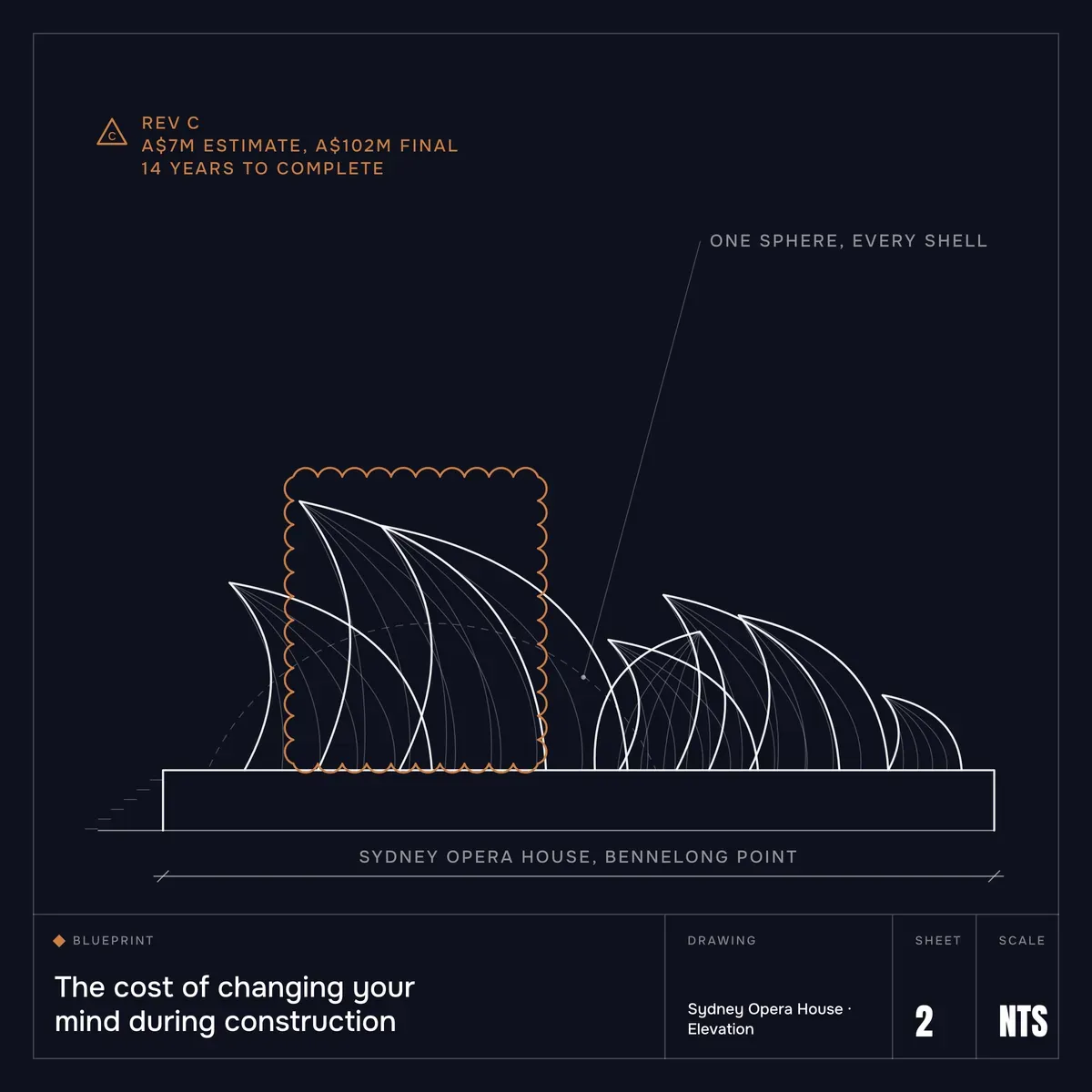
The result was not simply a higher construction bill. It was years of additional engineering, coordination and programme disruption. The project eventually took fourteen years to complete, and its final cost was approximately A$102 million, compared with an original estimate of A$7 million. While several factors contributed to that increase, starting construction before resolving critical design issues became one of the defining lessons of the project.
Today, the Opera House is celebrated as a masterpiece.
It is also studied around the world as a reminder that construction should not race ahead of design.
Small Changes, Big Consequences
This lesson applies just as much to a family home as it does to a landmark building.
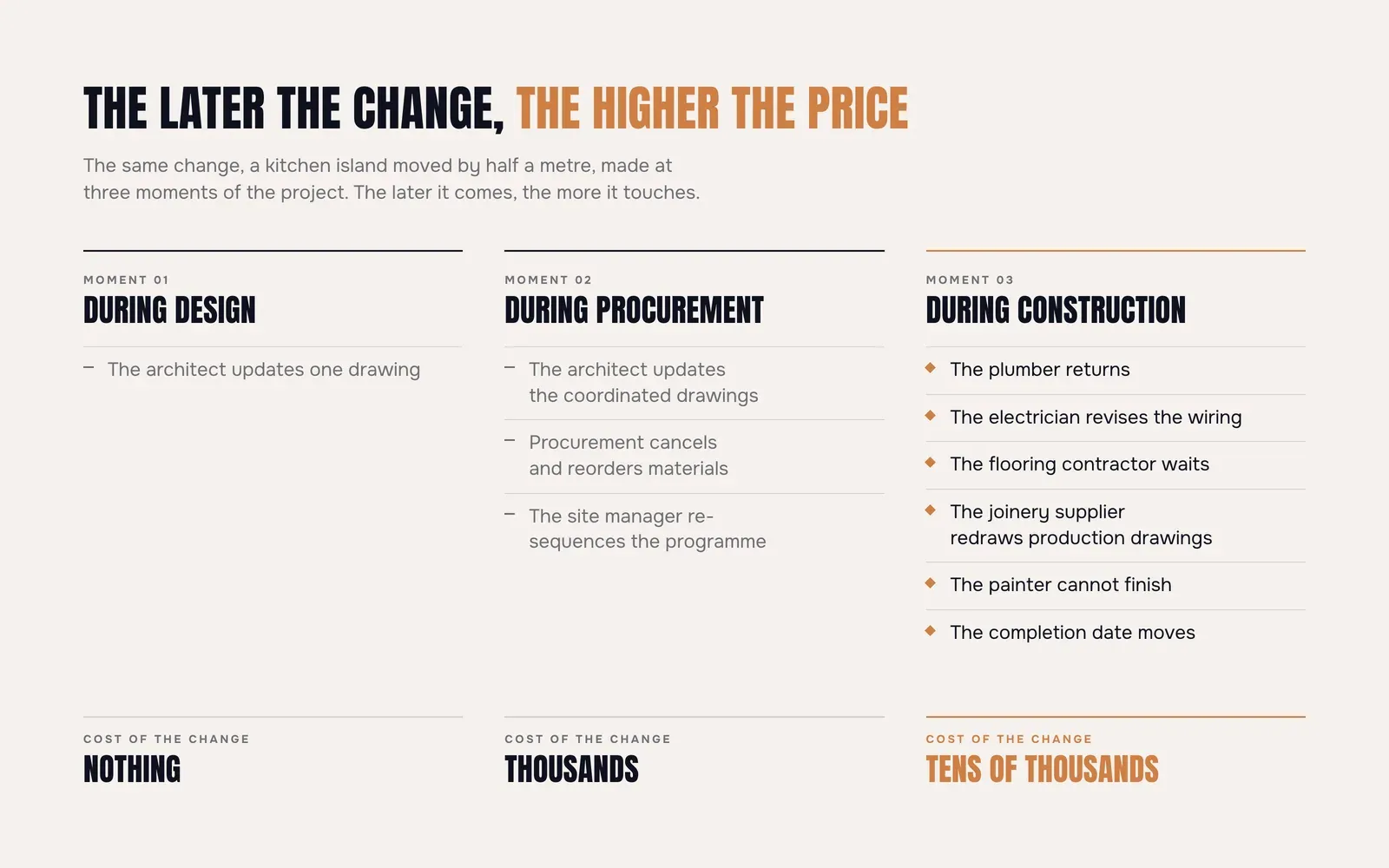
Imagine a homeowner decides to move the kitchen island after plumbing has already been installed.
The plumber returns.
The electrician revises wiring.
The flooring contractor waits.
The joinery supplier changes production drawings.
The painter cannot finish.
The completion date moves.
The client only changed one feature, but five different trades had to change their work.
Construction professionals often refer to this as the ripple effect. Every decision affects the work that follows, and the later a change is made, the larger those ripples become.
The Numbers Tell the Story
Research consistently supports what experienced contractors already know.
A study published in the Journal of Construction Engineering and Management, analysing 359 construction projects, found that the direct cost of rework alone averaged around 5% of total construction costs. That figure does not include many indirect costs such as delays, disrupted productivity or management time.
The Construction Industry Institute also found that projects experiencing frequent changes suffer measurable reductions in labour productivity. Workers lose momentum, supervisors spend more time coordinating revisions and contractors are forced to resequence work that was originally planned to happen only once.
Perhaps the most valuable lesson is not that changes are expensive.
It is that late changes are disproportionately expensive.
A decision that costs nothing during design can cost thousands during procurement and tens of thousands once construction is underway.
Good Projects Make Difficult Decisions Early
There is a common misconception that successful projects are those that solve problems quickly.
In reality, the best projects prevent many of those problems from appearing in the first place.
That is why experienced project teams invest so much time reviewing drawings, coordinating consultants, challenging assumptions and asking difficult questions before work begins on site. Those meetings may feel slow, but they are usually far cheaper than making the same decisions halfway through construction.
Danish economic geographer Bent Flyvbjerg, the Villum Kann Rasmussen Professor at the IT University of Copenhagen and Professor Emeritus at the University of Oxford, often argues that successful projects should “think slow, act fast.” In other words, spend more time making the right decisions before construction starts, so execution can move with confidence once it begins. That idea runs against the pressure many projects face to “just get started,” but decades of research suggest it leads to better outcomes.
The Cheapest Change Is the One You Never Have to Make
Every construction project will experience some level of change. That is part of building. New information emerges, conditions evolve and genuine improvements are sometimes worth pursuing.
The real challenge is recognising that every late decision carries a hidden price. It is not measured only in materials or labour. It is measured in lost momentum, disrupted coordination, delayed procurement and opportunities that can never be recovered.
The most successful projects are not the ones that avoid every problem. They are the ones that make the important decisions early enough that construction can focus on what it does best: building.
Sources
- Construction Industry Institute (CII) – The Impact of Changes on Construction Cost and Schedule
https://www.construction-institute.org/the-impact-of-changes-on-construction-cost-and-schedule 2. Construction Industry Institute (CII) – Construction Changes and Change Orders: Their Magnitude and Impact
https://www.construction-institute.org/construction-changes-and-change-orders-their-magnitude-and-impact 3. Construction Industry Institute (CII) – Quantitative Effects of Project Change
https://www.construction-institute.org/quantitative-effects-of-project-change 4. Journal of Construction Engineering and Management – Measuring the Impact of Rework on Construction Cost Performance
https://doi.org/10.1061/(ASCE)0733-9364(2009)135:3(187) 5. Bent Flyvbjerg – Policy and Planning for Large Infrastructure Projects: Problems, Causes, Cures