The Buildings That Refused to Become Waste
Adaptive reuse, circular construction and better data show that the greenest building is often the one that already exists.
Some of the world’s most celebrated buildings exist today because somebody chose adaptation instead of demolition.
The Empire State Building is one of the most famous examples. Completed in 1931, it could easily have become another victim of redevelopment as office expectations changed throughout the twentieth century. Instead, its owners invested more than $550 million in a comprehensive refurbishment programme that dramatically improved energy performance while preserving the building’s structure. The retrofit reduced energy consumption by nearly 40%, lowered operating costs and extended the useful life of one of the world’s most recognisable skyscrapers.
The environmental benefits were significant.
So were the commercial ones.
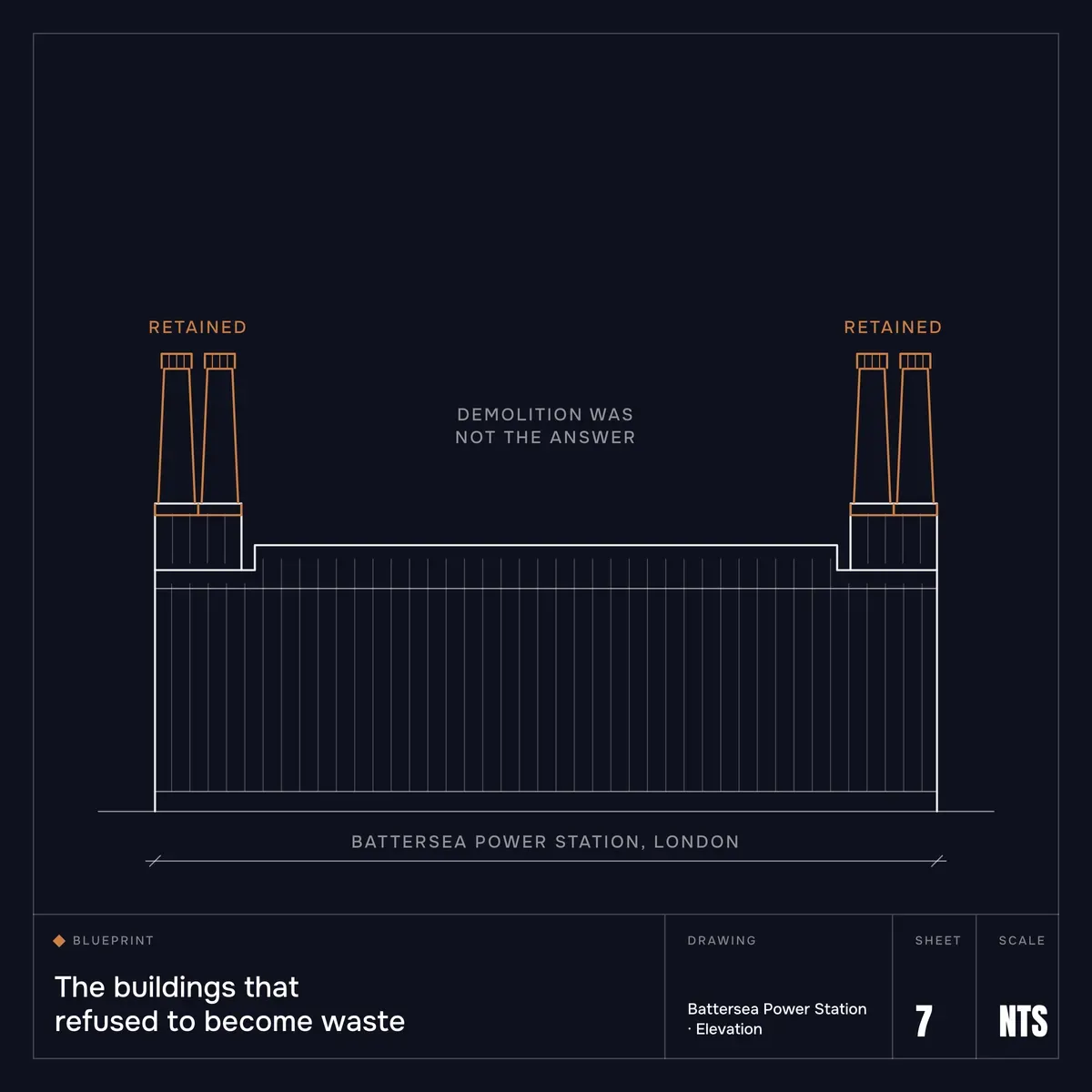
London offers another compelling lesson through Battersea Power Station. For decades the enormous brick structure stood abandoned, leading many to question whether demolition was inevitable. Instead, an ambitious regeneration programme transformed the former coal-fired power station into a mixed-use development of offices, homes, shops and public spaces. The project preserved one of Britain’s most recognisable industrial landmarks while avoiding the enormous environmental impact of replacing the entire structure.
A similar story can be found at Tate Modern. Rather than constructing a new museum from scratch, architects Herzog & de Meuron reimagined the disused Bankside Power Station. Today it is one of the world’s most visited museums, attracting millions of visitors each year while demonstrating that adaptive reuse can create buildings every bit as iconic as entirely new developments.
These projects differ in scale, purpose and location.
They share one important principle.
Their greatest environmental achievement was recognising the value that already existed.
Demolition Should Be the Last Option
Demolition is sometimes unavoidable. Buildings reach the end of their structural life. Safety concerns emerge. Urban needs change. Some structures simply cannot be adapted economically or technically.
But for decades, demolition has often been treated as the starting point rather than the final option.
That approach is beginning to change.
Governments, investors and developers are increasingly asking whether an existing structure can be reused before approving complete redevelopment. Financial institutions are incorporating environmental, social and governance (ESG) objectives into investment decisions. Planning authorities are placing greater emphasis on whole-life carbon assessments. Clients are beginning to recognise that retaining structural elements can reduce programme durations, minimise waste and strengthen sustainability credentials without compromising commercial outcomes.
In many cases, preserving a building is no longer simply an environmental decision.
It is becoming a business decision.
Replace or Reuse?
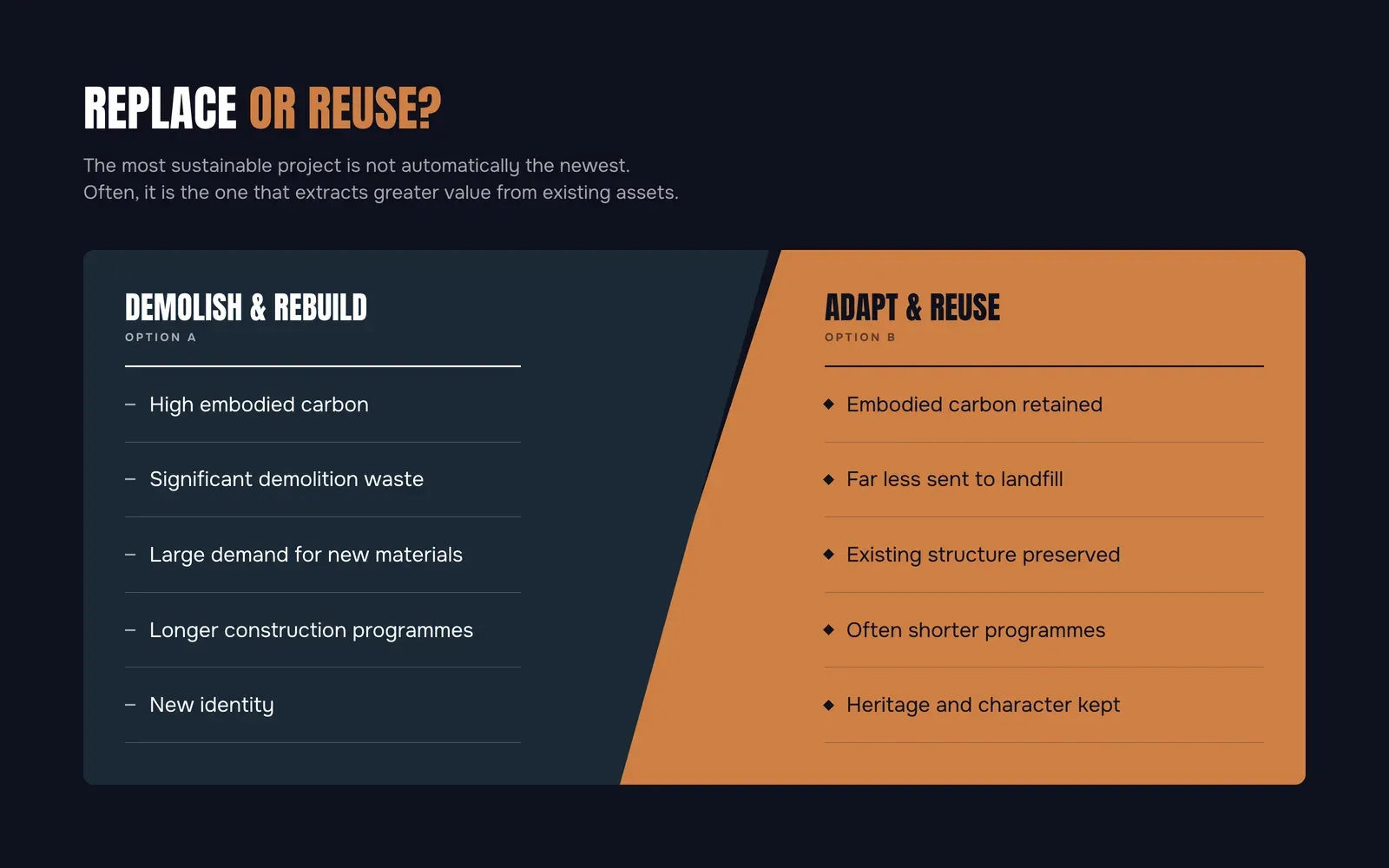
Key Insight: The most sustainable project is not automatically the newest. Often, it is the one that extracts greater value from existing assets.
The Circular Economy Is Redefining Construction
For generations, construction followed a straightforward model.
Extract raw materials.
Build.
Use.
Demolish.
Repeat.
It delivered remarkable cities, but it also depended on the assumption that resources would always remain plentiful and inexpensive.
The circular economy challenges that assumption. Rather than treating buildings as disposable assets with fixed lifespans, it encourages designers, engineers and developers to think of structures as repositories of future value. Materials are reused rather than discarded. Components are refurbished rather than replaced. Buildings evolve instead of being erased.
This represents more than a change in construction methods.
It is a change in philosophy.
A building should not be judged solely by how efficiently it performs today.
It should also be judged by how successfully it can adapt tomorrow.
From Linear to Circular Construction
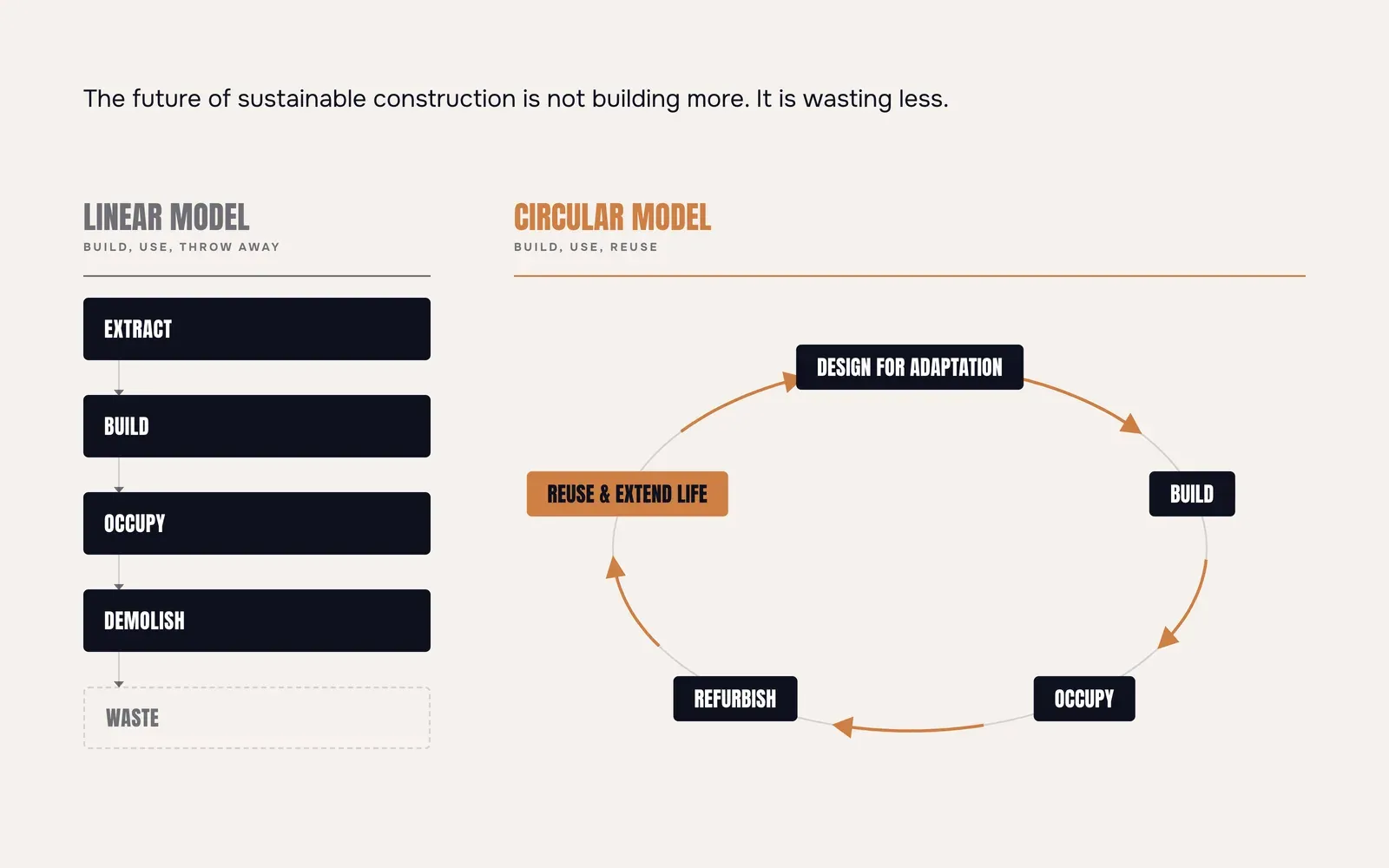
Key Insight: The future of sustainable construction is not building more. It is wasting less.
Technology Is Helping Us Preserve More Than Ever Before
Ironically, some of the most advanced technologies in construction are making a stronger case for older buildings.
Digital twins, laser scanning, structural health monitoring and artificial intelligence now provide engineers with unprecedented insight into the condition of existing assets. Instead of relying solely on visual inspections or assumptions, project teams can analyse structural performance, predict maintenance requirements and identify opportunities for refurbishment with remarkable accuracy.
AI is already supporting this transition. Platforms such as Bentley iTwin create digital replicas of infrastructure assets that help owners understand how buildings perform over time. Autodesk Forma assists in evaluating redevelopment options during early planning stages, while structural monitoring technologies increasingly use machine learning to detect deterioration before it becomes critical.
The question is no longer simply whether a building can be saved.
Increasingly, we have the data needed to determine how.
Technology is changing the conversation from demolition by default to preservation by evidence.
Rethinking What Progress Looks Like
Construction has always been an industry that creates.
New homes.
New schools.
New hospitals.
New infrastructure.
That mission will never disappear, nor should it. Growing populations, changing communities and ageing infrastructure ensure that new construction will remain essential for generations to come.
But perhaps the industry’s definition of progress is beginning to evolve.
Success may no longer be measured only by the number of buildings we complete, but by the wisdom with which we decide what deserves to remain. Every beam retained, every facade restored and every structure adapted represents more than a design decision. It reflects a growing understanding that sustainability is not achieved simply by building differently. It is achieved by thinking differently about value, longevity and responsibility.
Future generations will inherit the choices we make today.
Not only the buildings we create.
But the buildings we choose to preserve.
Because the greenest building is not always the one with the latest technology, the highest environmental rating or the most impressive architectural renderings.
Sometimes, it is the one that has already stood the test of time.
Sources
- World Green Building Council. Bringing Embodied Carbon Upfront.
- RICS. Whole Life Carbon Assessment for the Built Environment.
- UK Green Building Council. Net Zero Carbon Buildings Framework.
- International Energy Agency (IEA). Buildings Sector Report.
- Ellen MacArthur Foundation. Completing the Picture: Circular Economy for Climate.
- Architecture 2030. Embodied Carbon Resources.
- Historic England. Heritage and Carbon in the Built Environment.
- Empire State Realty Trust. Empire State Building Sustainability Reports.
- Battersea Power Station Development Company. Sustainability and Regeneration Reports.
- Tate Modern & Herzog & de Meuron. Adaptive Reuse Project Documentation.