Most Construction Problems Aren’t Construction Problems
What 5,000 years of building can teach us about delivering better projects today.
Walk onto almost any construction site where a project is running behind schedule and you’ll probably hear the same explanations.
“We’re waiting for materials.” “The contractor has fallen behind.” “The weather hasn’t helped.” “Labour has been difficult to find.”
These problems are real, and they affect projects every day. However, history suggests they are rarely where the project first started to go wrong.
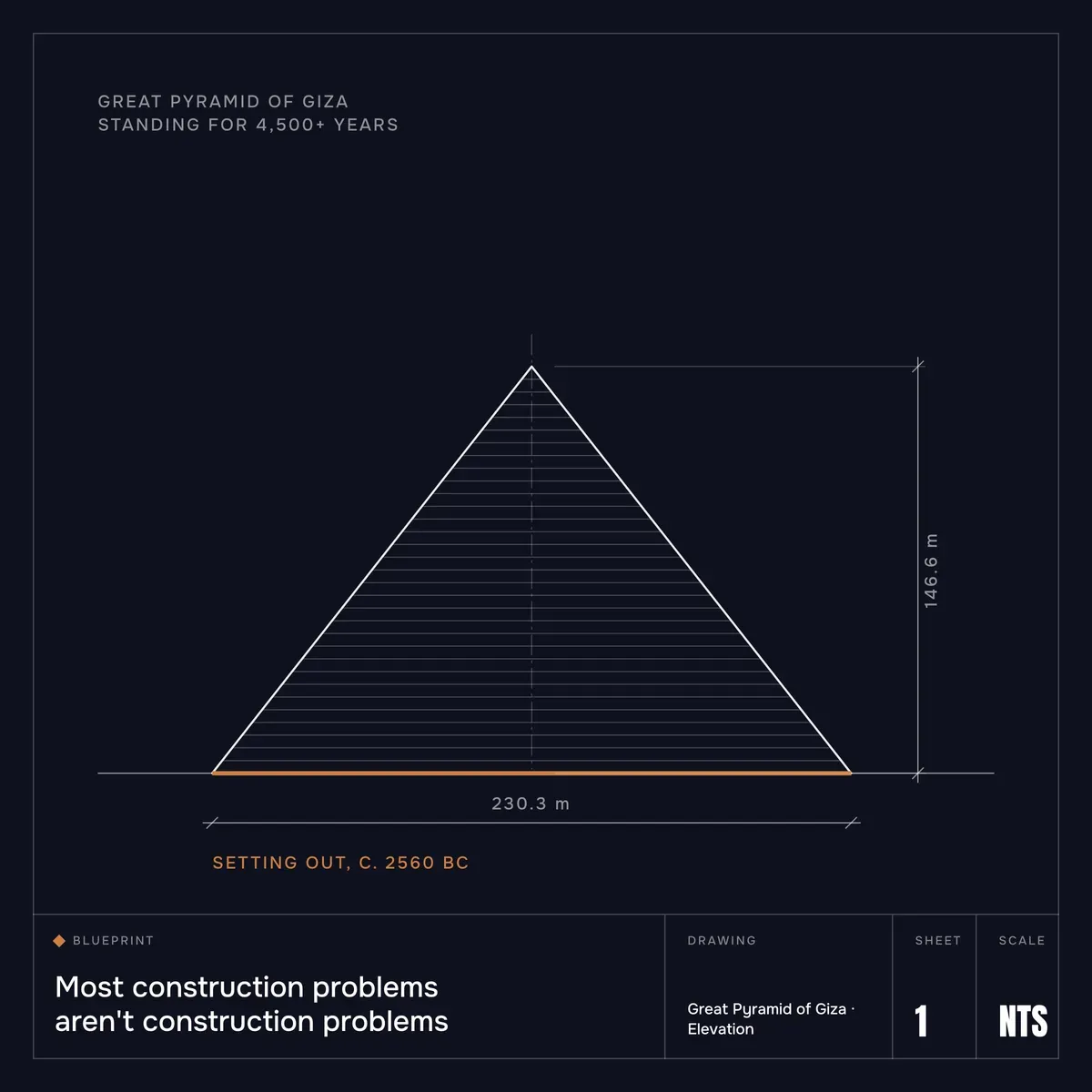
For more than 5,000 years, from the Great Pyramid of Giza to the Burj Khalifa, the biggest construction problems have rarely been caused by construction itself. They have almost always begun much earlier—during planning, design or procurement. By the time the first excavator arrives on site, the project’s direction has already been shaped by hundreds, sometimes thousands, of decisions.
That lesson has survived every technological revolution our industry has experienced. We build taller, faster and with greater precision than ever before, yet the importance of making good decisions early has remained unchanged throughout history.
Every Great Building Started as a Decision
The Great Pyramid of Giza still stands after more than 4,500 years. The Pantheon in Rome remains the largest unreinforced concrete dome ever built. The Brooklyn Bridge transformed engineering in the nineteenth century, while the Burj Khalifa redefined what modern construction could achieve.
These projects belong to different civilisations and different centuries, yet they all have something in common. They did not become successful simply because skilled people worked hard on site. They succeeded because planning, engineering, logistics and organisation were treated as part of the construction process from the very beginning.
The Romans understood this remarkably well. Building thousands of kilometres of roads, bridges and aqueducts required much more than talented engineers. Surveying, sourcing materials, organising labour and planning routes were all essential long before construction crews began their work. The visible construction was only the final step in a much longer process.
Today’s projects rely on BIM models, drones, digital twins and advanced project management software. The tools have changed dramatically. The principles have not.
When Construction Gets the Blame
Construction is the most visible stage of any project, so when something goes wrong it naturally attracts the most attention. Cranes stop moving, workers wait for instructions, deliveries are delayed and programmes begin to slip. From the outside, it appears that construction is failing.
In reality, construction is often dealing with problems that were created months or even years earlier. A delayed planning approval, incomplete design information, late client decisions or procurement packages issued before drawings were fully coordinated may seem like small issues at the time. By the time construction begins, however, those early decisions can have a significant impact on cost, programme and productivity.
The Sydney Opera House is one of the clearest examples. Construction began in 1959 before the iconic roof structure had been fully engineered. As architects and engineers continued solving fundamental design challenges, the programme became increasingly difficult to manage. Costs escalated, schedules slipped and the project attracted international criticism. Construction appeared to be the problem, but in reality it was responding to decisions that had been made much earlier.
Danish economic geographer Bent Flyvbjerg, the Villum Kann Rasmussen Professor at the IT University of Copenhagen and Professor Emeritus at the University of Oxford, is one of the world’s leading researchers on megaprojects. He frequently uses the Sydney Opera House as an example of why projects should avoid rushing into construction before critical planning has been completed. His research shows that starting earlier rarely means finishing sooner.
The Same Story Repeats Itself
The Sydney Opera House is far from being an isolated example. Boston’s Big Dig became one of the most ambitious infrastructure projects ever undertaken in the United States. While the engineering challenges were extraordinary, later reviews found that planning complexity, changing scope and coordination between multiple organisations all contributed significantly to delays and cost increases.
London’s Crossrail tells a similar story. Although it is now recognised as one of Europe’s greatest infrastructural achievements, integrating tunnels, stations, railway systems and digital signalling proved considerably more complex than originally expected. Construction teams often found themselves managing the consequences of decisions that had been made years before work reached site.
Although these projects were delivered in different countries, under different political systems and with vastly different budgets, they reveal the same underlying pattern. Construction was not the original source of the problems. It simply became the stage where those problems could no longer be hidden.
The Hidden Timeline of a Delay
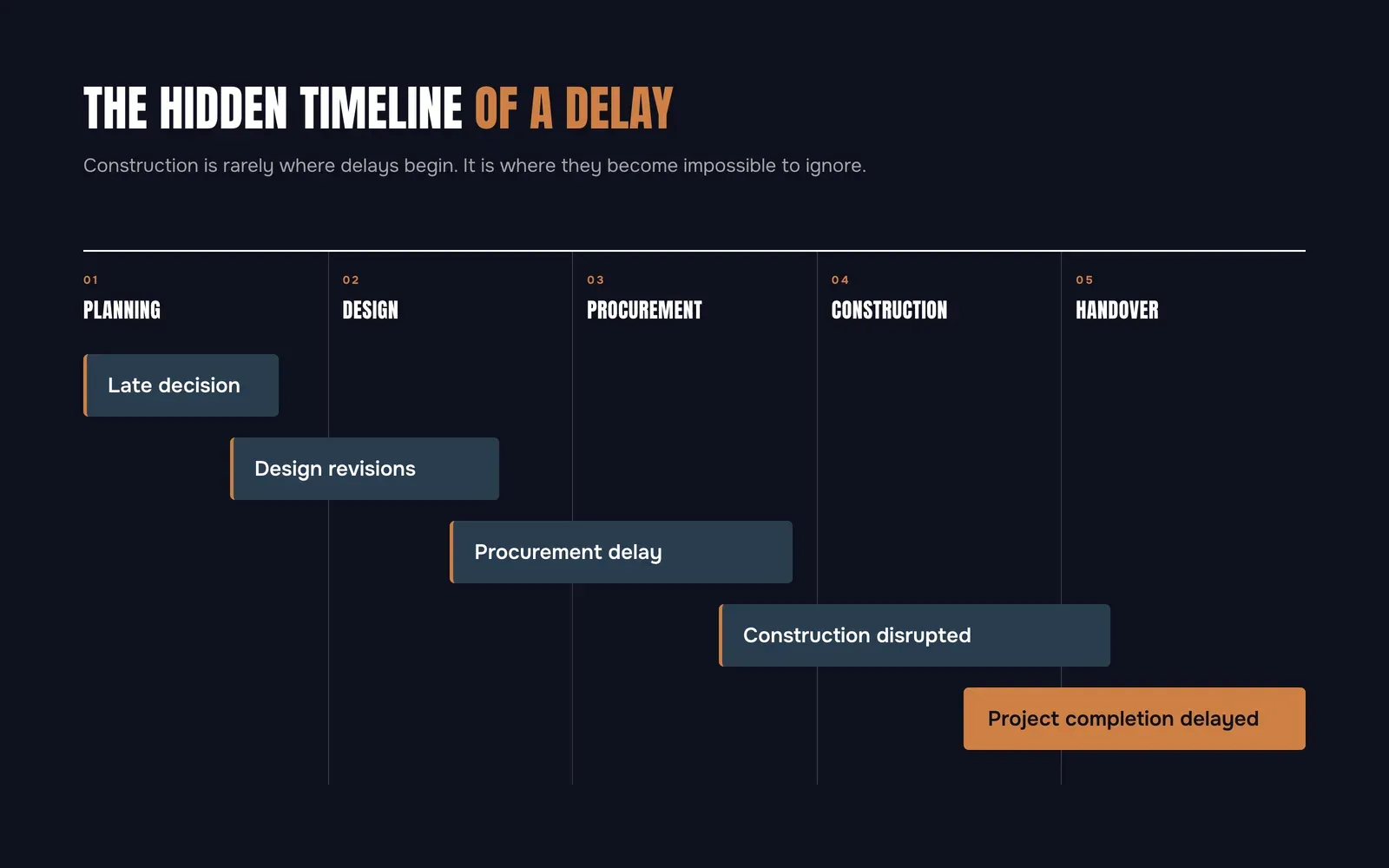
Planning → Design → Procurement → Construction → Handover
Late decision → Design revisions → Procurement delay → Construction disrupted → Project completion delayed
Construction is rarely where delays begin. It is where they become impossible to ignore.
The construction site is where everyone notices a problem, but it is rarely where that problem started. A design issue that takes an afternoon to resolve before procurement may take weeks to correct once steel has been fabricated or concrete has already been poured. The later a problem is discovered, the more expensive and disruptive it becomes.
This is why experienced project teams invest so much time in planning, coordination and design reviews before breaking ground. Every issue solved on paper reduces the likelihood of costly changes once construction is underway.
Small Projects Follow the Same Principles
It is easy to assume these lessons only apply to billion-euro infrastructure projects, but the same principles apply to projects of every size.
Imagine a homeowner renovating a house. Kitchen layouts are approved later than expected, electrical drawings need updating and cabinets have already been ordered. Suddenly every contractor is waiting for someone else before they can continue. Although the financial impact is much smaller than on a major infrastructure project, the snowballing of events is exactly the same.
Whether a project costs €200,000 or €2 billion, the principle remains unchanged. Careful planning creates predictable outcomes, while poor planning creates uncertainty. The scale of the project may change, but the consequences of late decisions remain remarkably consistent.
History and Research Reach the Same Conclusion
One of the most interesting aspects of construction is that history and modern research arrive at almost identical conclusions.
Professor Flyvbjerg has spent decades studying hundreds of major projects around the world. His research consistently shows that the greatest risks are created during the earliest stages of a project, when optimism, incomplete information and rushed decisions combine. Once construction begins, many of those decisions become expensive to reverse.
The Project Management Institute reaches similar conclusions through its global Pulse of the Profession research. Organisations that invest more in planning, governance and early decision-making consistently deliver stronger results than those that rely on solving problems during construction.
The message is surprisingly simple. Successful projects are not defined by how well they recover from problems. They are defined by how many problems they prevent before construction even begins.
The Best Projects Rarely Need Heroes
The construction industry has always been full of talented problem-solvers. Engineers redesign structures, contractors recover programmes, suppliers find alternatives and project teams work tirelessly to keep projects moving when unexpected challenges arise. These skills are essential, and they will always be part of successful project delivery.
However, the projects that history remembers are rarely remembered because they overcame constant crises. They are remembered because careful planning, disciplined decision-making and strong coordination prevented many of those crises from happening in the first place.
Five thousand years separate the pyramids from today’s tallest skyscrapers. We have transformed our materials, machinery and technology, but we have not changed the importance of making good decisions before construction begins.
The next time a project falls behind schedule, it may be worth asking a different question. Instead of asking what went wrong on site, ask when the problem really began. History suggests the answer is almost always much earlier than we think.
Sources
- Bent Flyvbjerg & Dan Gardner — How Big Things Get Done (2023)
https://www.penguinrandomhouse.com/books/697489/how-big-things-get-done-by-bent-flyvbjerg-and-dan-gardner/ 2. Oxford Global Projects — Research by Professor Bent Flyvbjerg
https://globalprojects.ox.ac.uk/ 3. Project Management Institute (PMI) — Pulse of the Profession
https://www.pmi.org/learning/thought-leadership/pulse 4. Sydney Opera House — Official History
https://www.sydneyoperahouse.com/our-story 5. Crossrail Learning Legacy — Lessons from Europe’s largest infrastructure programme
https://learninglegacy.crossrail.co.uk/ 6. Federal Highway Administration — Boston Central Artery / Big Dig Project
https://www.fhwa.dot.gov/ipd/project_profiles/ma_central_artery.aspx