Malta’s Next Construction Boom Could Be About Building Better.
For two decades, Malta’s construction industry has been defined by expansion. The next chapter will be shaped by something far more difficult: creating places that deliver lasting value.
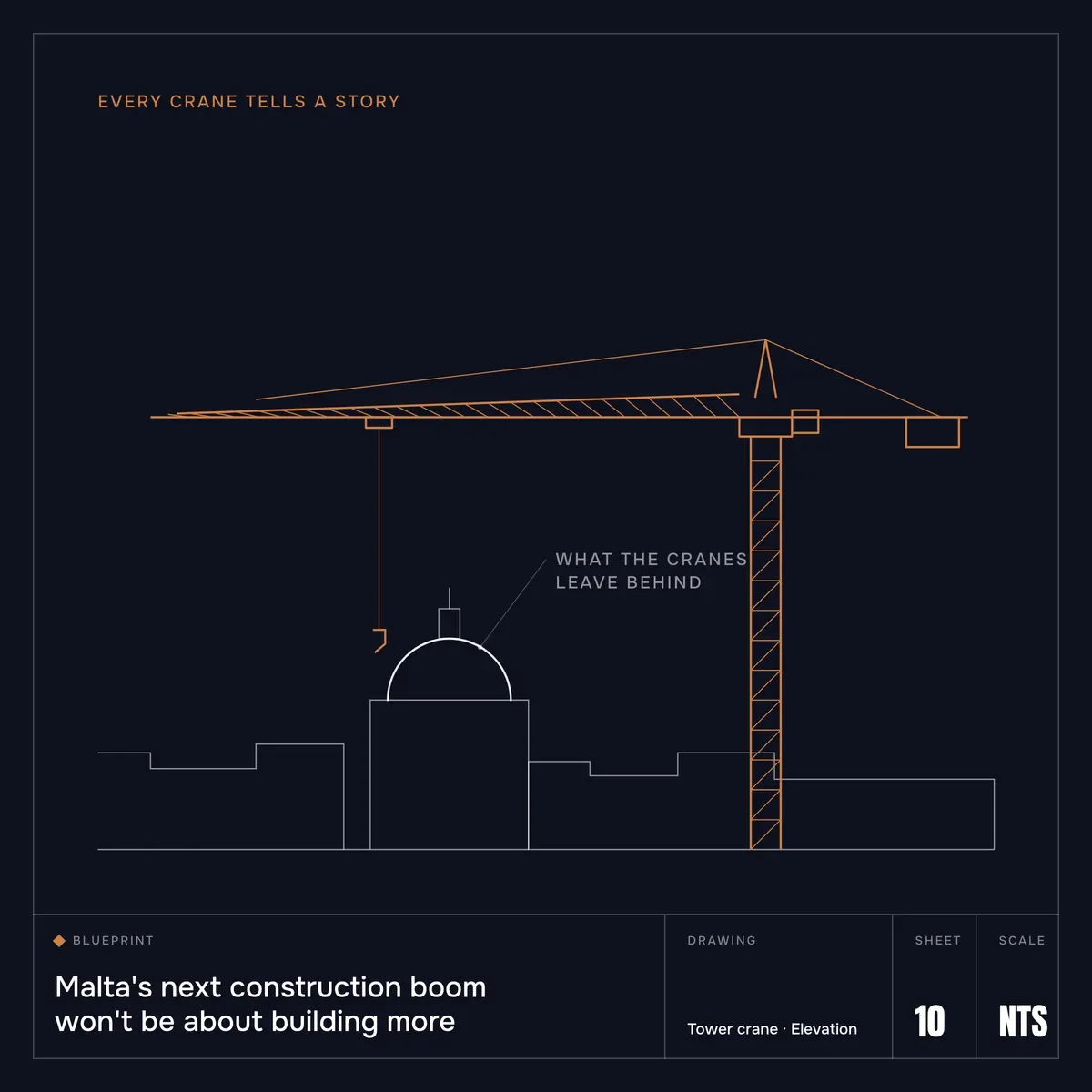
Construction cranes have become so familiar across Malta that they are almost invisible. They rise above the waterfronts of Sliema and Gżira, dominate the skyline of St Julian’s, overlook the business district of Mrieħel and punctuate towns and villages across the island. For many people, they have become part of the landscape itself—a permanent feature of an economy that has spent more than two decades reinventing itself.
Every crane tells a story.
It speaks of confidence, investment and ambition. New residential developments have accommodated a rapidly growing population. Office buildings have supported the expansion of financial services, technology companies and international businesses. Hotels have welcomed record numbers of visitors, while infrastructure projects have attempted to keep pace with an economy that has consistently outperformed many of its European neighbours.
Construction has not simply followed Malta’s economic growth.
It has made that growth possible.
Few industries have influenced the country’s transformation as profoundly. They have created homes for new residents, workplaces for expanding businesses and the physical foundations upon which modern Malta has built its prosperity. Judged by these measures, the industry has been remarkably successful. It responded to unprecedented demand with extraordinary speed, delivering thousands of projects that reshaped the island within a single generation.
Yet every successful industry eventually reaches a turning point.
The questions that once defined success begin to change. Meeting demand is no longer the only objective. Growth alone is no longer enough. As economies mature and available land becomes increasingly scarce, the conversation naturally shifts from how much can we build? to what deserves to be built, where should it be built and how can every project create lasting value?
For Malta, that moment may already have arrived.
The country’s next construction boom is unlikely to be measured by the number of cranes above its skyline. It will be measured by something far less visible but ultimately more important: the quality of the places those cranes leave behind.
From Expansion to Maturity
Malta’s recent history is, in many ways, a construction story.
Membership of the European Union, sustained economic growth, increasing foreign direct investment and the rapid expansion of industries such as iGaming, aviation, financial services and tourism created demand unlike anything the country had experienced before. More businesses required more offices. More workers required more housing. More visitors required more hotels and supporting infrastructure. Construction became one of the principal engines translating economic opportunity into physical reality.
The pace of development reflected the urgency of the moment. Speed mattered because demand was immediate. Investors wanted projects delivered quickly, businesses required operational space and residential developments struggled to keep pace with population growth. Delivering projects efficiently became a competitive advantage, and the industry adapted accordingly.
It would be easy to criticise this period with the benefit of hindsight.
That would also be unfair.
Construction delivered precisely what Malta needed at the time. Without that expansion, many of the sectors that now define the country’s economy could never have grown at the pace they did. The buildings constructed over the past twenty years represent far more than concrete and limestone. They represent employment, investment, entrepreneurship and economic resilience.
Success, however, creates its own challenges.
An island has finite boundaries. Every new development changes not only the site on which it stands but also the neighbourhood around it. Roads become busier. Infrastructure faces greater pressure. Public spaces become increasingly valuable. Decisions about individual buildings begin influencing the quality of entire communities.
As development intensifies, construction stops being solely about buildings.
It becomes about places.
Malta’s Construction Evolution
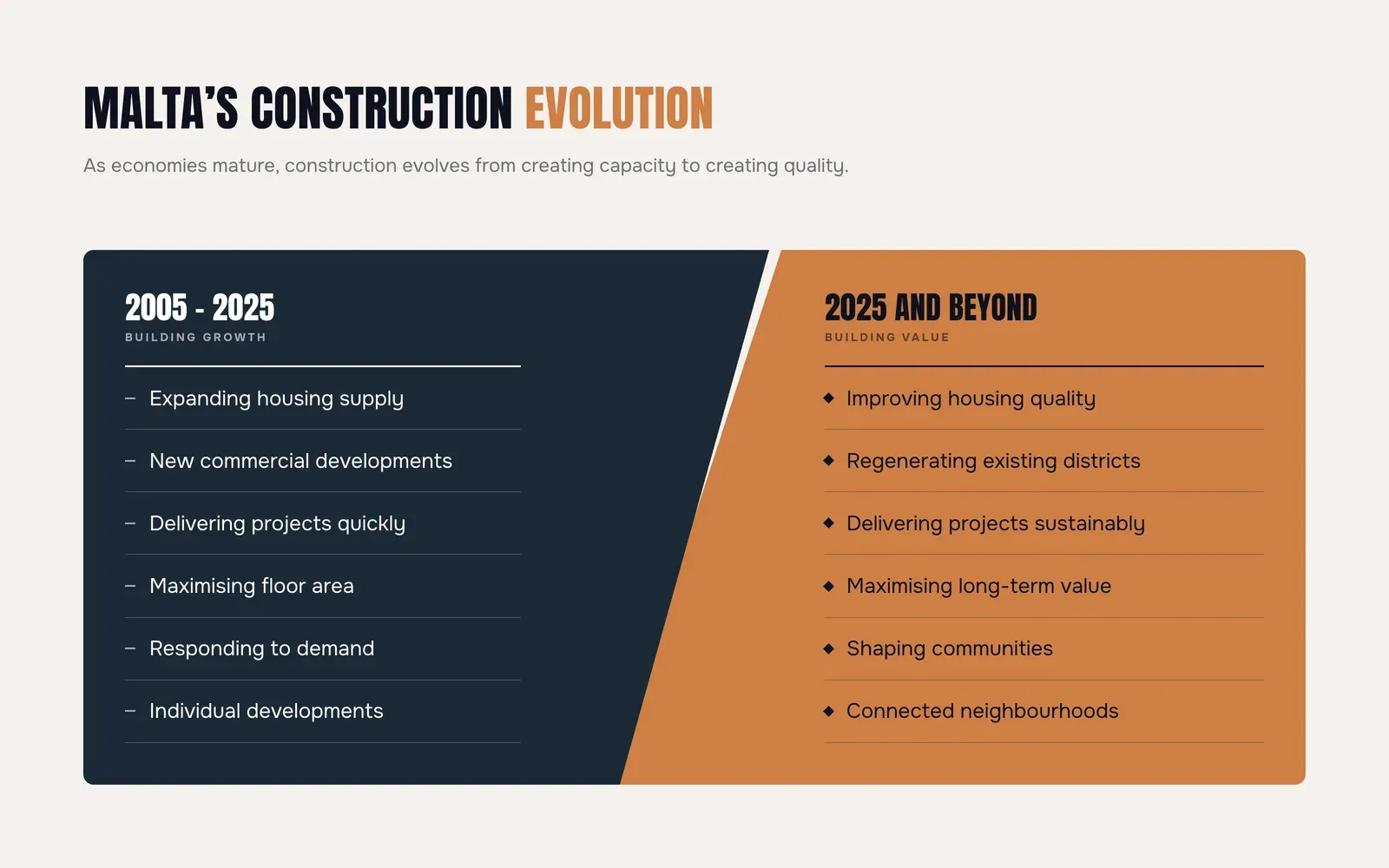
Key Insight: As economies mature, construction evolves from creating capacity to creating quality.
An Island Changes the Rules
Construction is shaped by geography.
In countries with abundant land, growth often means expanding outward. New districts emerge beyond existing urban centres, allowing cities to absorb demand while gradually extending infrastructure.
Malta does not have that luxury.
Its greatest strength—its compact size—is also one of its greatest planning challenges. Every square metre carries exceptional value, and every significant development influences transport networks, utilities, public services and neighbouring communities. Decisions that might have relatively local consequences elsewhere often have island-wide implications in Malta.
This changes the economics of construction.
It also changes the responsibility that accompanies development.
When land is abundant, replacing buildings is relatively straightforward. When land is limited, every project becomes a long-term decision. A poorly designed building may occupy one of the country’s most valuable sites for generations. Conversely, a thoughtful development can improve an entire district, attracting investment, supporting businesses and enhancing the quality of urban life far beyond its own boundaries.
This is why many of the world’s most successful island economies eventually shift their focus.
They stop asking how to build more.
They begin asking how to build better.
Singapore provides perhaps the clearest example. Faced with severe land constraints, it gradually transformed its planning philosophy from rapid expansion towards integrated urban development. Regeneration, mixed-use communities, public transport, green infrastructure and long-term planning became central to national competitiveness. Economic success was no longer measured solely by construction output but by the quality and resilience of the built environment.
Malta’s circumstances are different.
The lesson, however, remains remarkably similar.
Land scarcity rewards quality.
The Next Competitive Advantage Is Not Height
For decades, success in construction has often been easy to recognise.
A taller building.
A larger development.
A faster programme.
A greater number of completed projects.
These are visible achievements, and they remain important. Yet they tell only part of the story.
Increasingly, investors, occupiers and communities evaluate projects using different criteria. Buildings are expected to consume less energy, adapt to changing uses, support healthier working environments and remain commercially viable for decades rather than years. Developments are judged not only by their architecture but also by how they contribute to the streets, businesses and neighbourhoods surrounding them.
This represents a profound shift in thinking.
The competitive advantage of the next decade will not belong exclusively to those who build the most.
It will belong to those who create the greatest long-term value.
For developers, this means looking beyond initial capital costs and considering lifecycle performance. For consultants, it requires integrating sustainability, flexibility and operational efficiency from the earliest design stages. For contractors, it increasingly demands digital delivery, better coordination and greater certainty rather than simply faster construction.
The definition of a successful project is changing.
The industry must change with it.
Quantity vs Quality
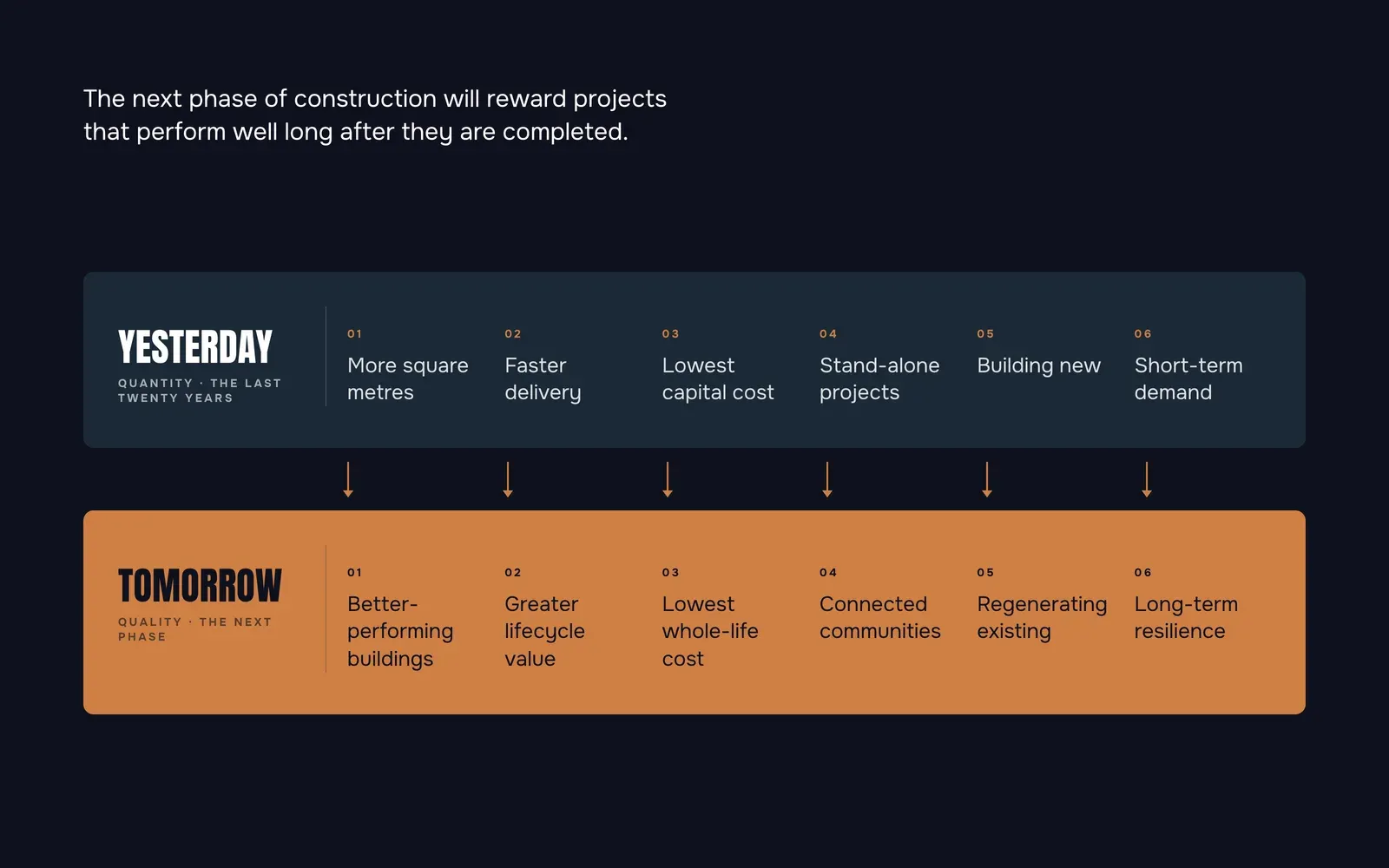
Key Insight: The next phase of construction will reward projects that perform well long after they are completed.