Designing Buildings for Generations
Why the best buildings aren’t designed for today’s owner—they’re designed for the next generation.
Walk through almost any European city and you’ll notice something remarkable.
Buildings that were designed hundreds of years ago are still being used every day.
People live in them.
Work in them.
Shop in them.
Eat in them.
Many continue serving the purpose they were built for, while others have adapted to entirely new lives.
Now compare that with many buildings constructed only thirty or forty years ago. Some are already being demolished, stripped back to their structure or undergoing expensive refurbishments because they no longer meet modern needs.
This raises an uncomfortable question.
Why do some buildings last for centuries while others struggle to reach a single generation?
The answer has surprisingly little to do with concrete, steel or brick.
It begins with design.
Good Buildings Survive Because They Can Adapt
When people think about durable buildings, they often imagine thicker walls, stronger concrete or better-quality materials.
Those things matter.
But history suggests these are only part of the story.
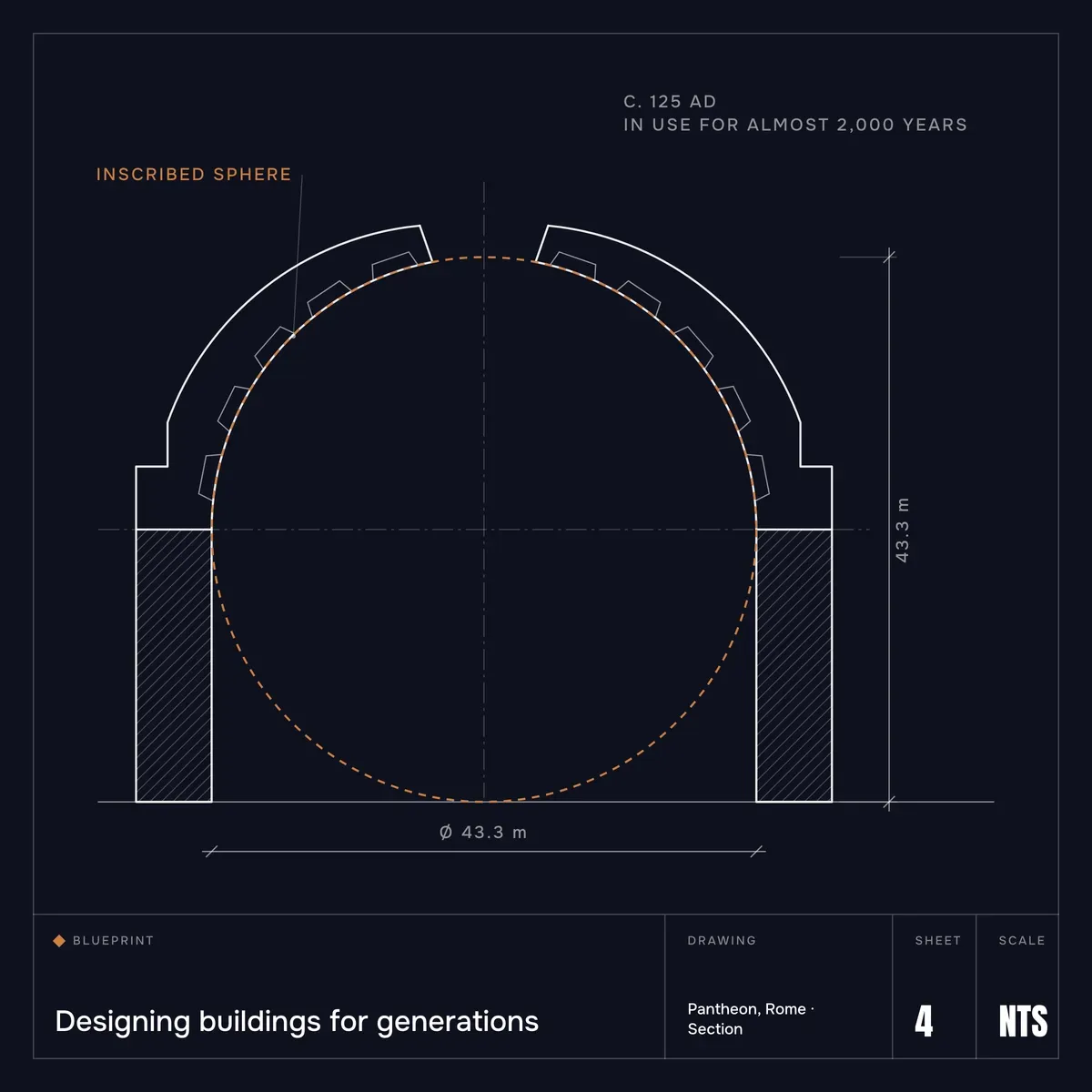
The Pantheon in Rome has stood for almost 2,000 years. It has survived earthquakes, wars, changing governments and changing religions. During its lifetime it has been a Roman temple, a Christian church and one of the world’s most visited landmarks.
Its greatest strength was not simply the quality of its concrete.
It was its ability to adapt.
The same principle can be seen across Europe. Former factories have become apartment buildings. Warehouses have become offices. Railway stations have become museums. Industrial buildings now house restaurants, hotels and universities.
Their designers could never have predicted these uses.
What they created was something flexible enough to evolve.
That flexibility became their greatest asset.
The Most Expensive Building Is Often the One That Doesn’t Last
Construction budgets usually focus on one number.
The cost to build.
Yet that figure tells only a small part of the story.
A building designed to save five percent during construction may require major refurbishment after twenty years.
Mechanical systems become obsolete.
Internal layouts no longer suit modern workplaces.
Energy performance falls below current standards.
Maintenance costs continue rising.
Eventually the owner faces a difficult decision:
Invest millions upgrading the building, or demolish it entirely.
The initial saving suddenly looks insignificant.
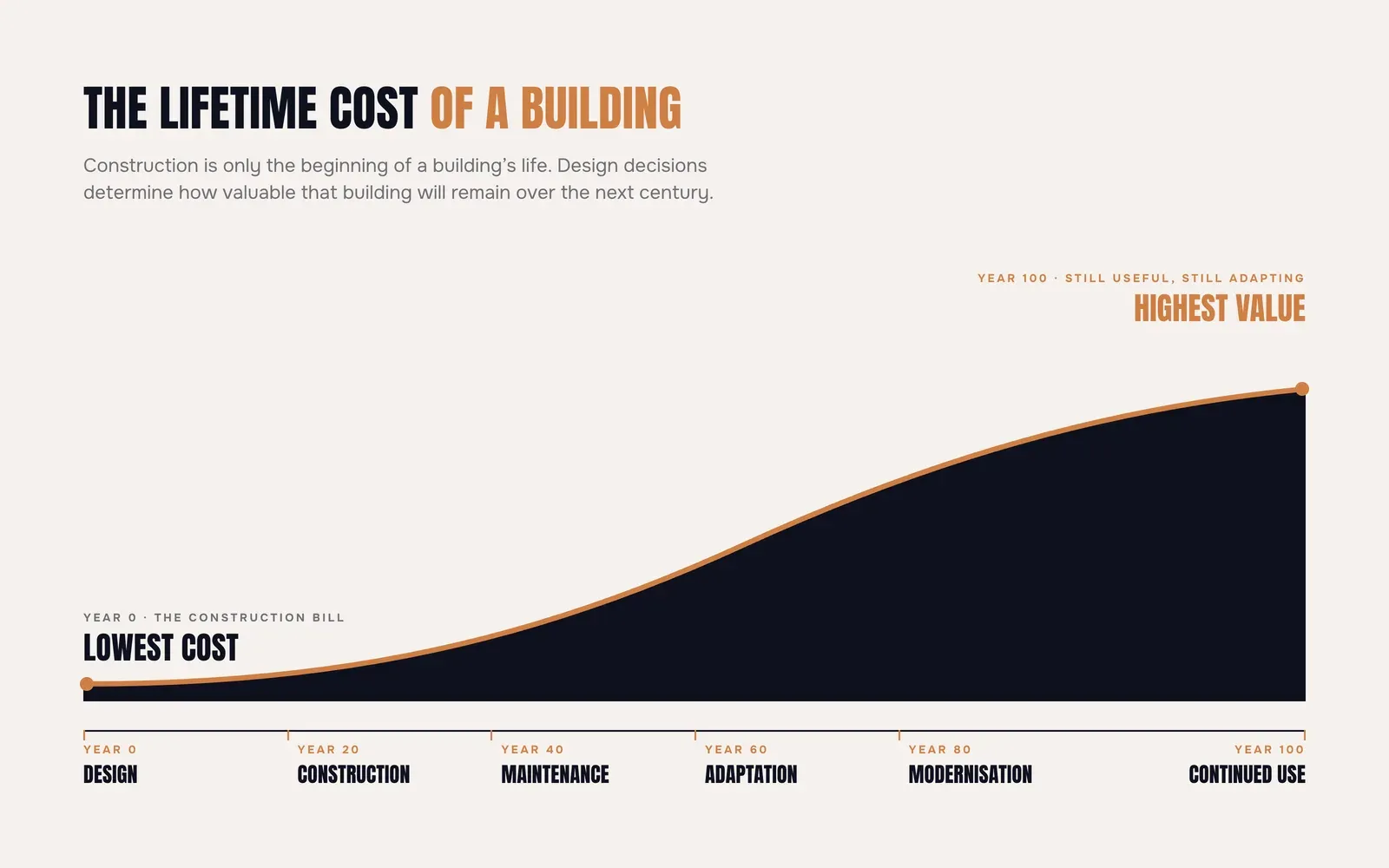
Researchers and property professionals increasingly use whole-life costing rather than construction cost alone because the majority of a building’s financial impact occurs after the keys have been handed over. According to the Royal Institution of Chartered Surveyors (RICS), decisions made during design influence operating, maintenance and replacement costs for decades after construction has finished.
Design is not simply about building.
It is about ownership.
The Buildings We Admire Were Never Designed to Be Temporary
Look at some of the world’s most admired buildings.
The Palace of Westminster.
The Flatiron Building.
The Empire State Building.
The Sydney Town Hall.
None of these buildings survived because they were fashionable.
They survived because they remained useful.
Some have been modernised many times. Electrical systems have been replaced. Heating has changed. Interiors have been remodelled. Accessibility has improved. Technology has been added.
Their success came from having a structure capable of accepting change instead of resisting it.
That is perhaps one of the greatest lessons modern construction can learn.
A building should not be designed around today’s technology.
Technology changes too quickly.
It should be designed around tomorrow’s unknown needs.
Short-Term Thinking Is Surprisingly Expensive
Modern construction often works under enormous commercial pressure.
Budgets are tight.
Programmes are shorter.
Developers want quicker returns.
Value engineering removes anything that appears unnecessary.
Sometimes these decisions make perfect commercial sense.
Sometimes they create expensive problems that emerge years later.
Lower floor-to-ceiling heights limit future uses.
Plant rooms leave no space for additional equipment.
Structures cannot support future rooftop installations.
Internal layouts make adaptation difficult.
Each decision may save money today.
Collectively they can reduce a building’s lifespan by decades.
The irony is that many buildings are demolished long before the structure itself has reached the end of its life.
The building hasn’t failed.
The design has become too inflexible to meet changing needs.
Sustainability Starts With Longevity
Discussions about sustainable construction often focus on recycled materials, electric machinery and low-carbon concrete.
All of these are important.
But perhaps the most sustainable building is the one that never needs replacing.
Demolition carries an enormous environmental cost. New materials require energy, transport and manufacturing. Every building replaced decades earlier than necessary represents carbon that could have been avoided.
This idea is becoming increasingly recognised across the industry. The World Green Building Council argues that reducing embodied carbon is not only about building differently—it is also about extending the life of existing buildings wherever possible.
Longevity is one of the most overlooked forms of sustainability.
A building that serves communities for a century is almost always a better environmental investment than one requiring replacement after thirty years.
The Best Design Anticipates Change
No architect can predict exactly how people will live or work fifty years from now.
Nobody designing offices in the 1980s imagined cloud computing.
Nobody designing shopping centres in the 1990s anticipated online retail at today’s scale.
Nobody designing buildings twenty years ago expected artificial intelligence to reshape workplaces.
The future always surprises us.
Good design accepts that reality.
Instead of creating buildings for one specific purpose, it creates buildings capable of evolving alongside society.
Large structural spans.
Flexible floorplates.
Accessible service zones.
Adaptable layouts.
These decisions rarely make newspaper headlines.
Yet they often determine whether a building remains valuable for generations.
Legacy Is Measured in Decades, Not Completion Dates
Construction projects are often judged on practical measures.
Did they finish on time?
Did they stay within budget?
Did they meet the specification?
Those questions matter.
But history asks different ones.
Is the building still useful?
Does it continue serving its community?
Can it adapt to changing needs?
Has it earned the right to remain?
The buildings we admire most rarely became successful because they were completed quickly or cheaply.
They became successful because they continued creating value long after the construction teams had left the site.
Perhaps that is the real purpose of design.
Not simply to create buildings that work today.
But to create buildings that future generations will still be grateful for.
Key Insight: Construction is only the beginning of a building’s life. Design decisions determine how valuable that building will remain over the next century.
Sources
- Royal Institution of Chartered Surveyors (RICS) – Whole Life Carbon Assessment for the Built Environment
https://www.rics.org/ 2. World Green Building Council – Bringing Embodied Carbon Upfront
https://worldgbc.org/ 3. Historic England – The Value of Adapting Historic Buildings
https://historicengland.org.uk/ 4. Stewart Brand – How Buildings Learn: What Happens After They’re Built (one of the most influential books ever written on adaptable buildings)
https://www.penguinrandomhouse.com/books/33068/how-buildings-learn-by-stewart-brand/ 5. The Institution of Structural Engineers – Guidance on designing adaptable and resilient structures