The Hidden Waste in Construction
The construction industry’s greatest losses are rarely found in skips or landfill. They’re hidden in time, decisions and opportunities that can never be recovered.
Walk onto almost any construction site and one thing immediately stands out.
Skips filled with timber offcuts. Pallets stacked for collection. Packaging waiting to be recycled. Surplus concrete hardening at the edge of a pour. These are the visible signs of waste, and for decades they have shaped how the construction industry measures its environmental and commercial performance.
The focus is understandable. Every discarded material represents money spent without creating value. Governments monitor recycling rates, clients demand sustainable practices and contractors work tirelessly to reduce what ends up in landfill. Across the industry, enormous progress has been made in using materials more efficiently than ever before.
Yet there is another form of waste that rarely attracts the same attention.
It cannot be photographed.
It never leaves the site.
And despite being largely invisible, it costs the industry far more than damaged materials ever will.
Imagine two projects of identical value.
On the first, a pallet of bricks is damaged during delivery. The loss is unfortunate, but it is quickly identified, replacements are ordered and work continues with only minor disruption.
On the second, an approval is delayed by four days because one design query remains unanswered. Procurement is postponed. A subcontractor is rescheduled. Labour stands idle. Equipment remains on hire. Other activities begin to slip as the programme adjusts around a decision that should have taken minutes instead of days.
No materials have been wasted.
Yet one project has lost far more value than the other.
Construction has become remarkably good at measuring what it throws away.
The next challenge is learning to measure what it never creates in the first place.
Waste Doesn’t Always Look Like Waste
Ask someone outside the construction industry what waste looks like and they will probably describe overflowing skips or demolition debris.
Ask an experienced project director the same question and the answer is often very different.
Waste is the crane waiting because materials have not arrived.
It is a design meeting that could have been resolved with one phone call.
It is skilled tradespeople standing idle because preceding work is incomplete.
It is the engineer searching through dozens of email chains to find the latest revision of a drawing.
None of these appear on environmental reports.
None are measured in tonnes.
Yet together they quietly consume the one resource no project can ever replace.
Time.
Unlike steel or concrete, time cannot be reordered.
Unlike timber, it cannot be recycled.
Once lost, it disappears forever.
Bent Flyvbjerg, whose research into megaproject performance has transformed the understanding of large-scale construction, argues that projects rarely fail because of one dramatic event. More often, they drift away from their objectives through countless small decisions, overlooked risks and incremental delays that compound over months or even years.
Construction rarely loses millions in a single afternoon.
It loses them one decision at a time.
The Most Expensive Delay Is Usually the First One
Every construction programme begins with optimism.
Schedules are carefully developed. Milestones are agreed. Procurement plans are aligned with construction sequences, and everyone involved believes the programme is achievable.
For a while, it usually is.
Then reality begins to intervene.
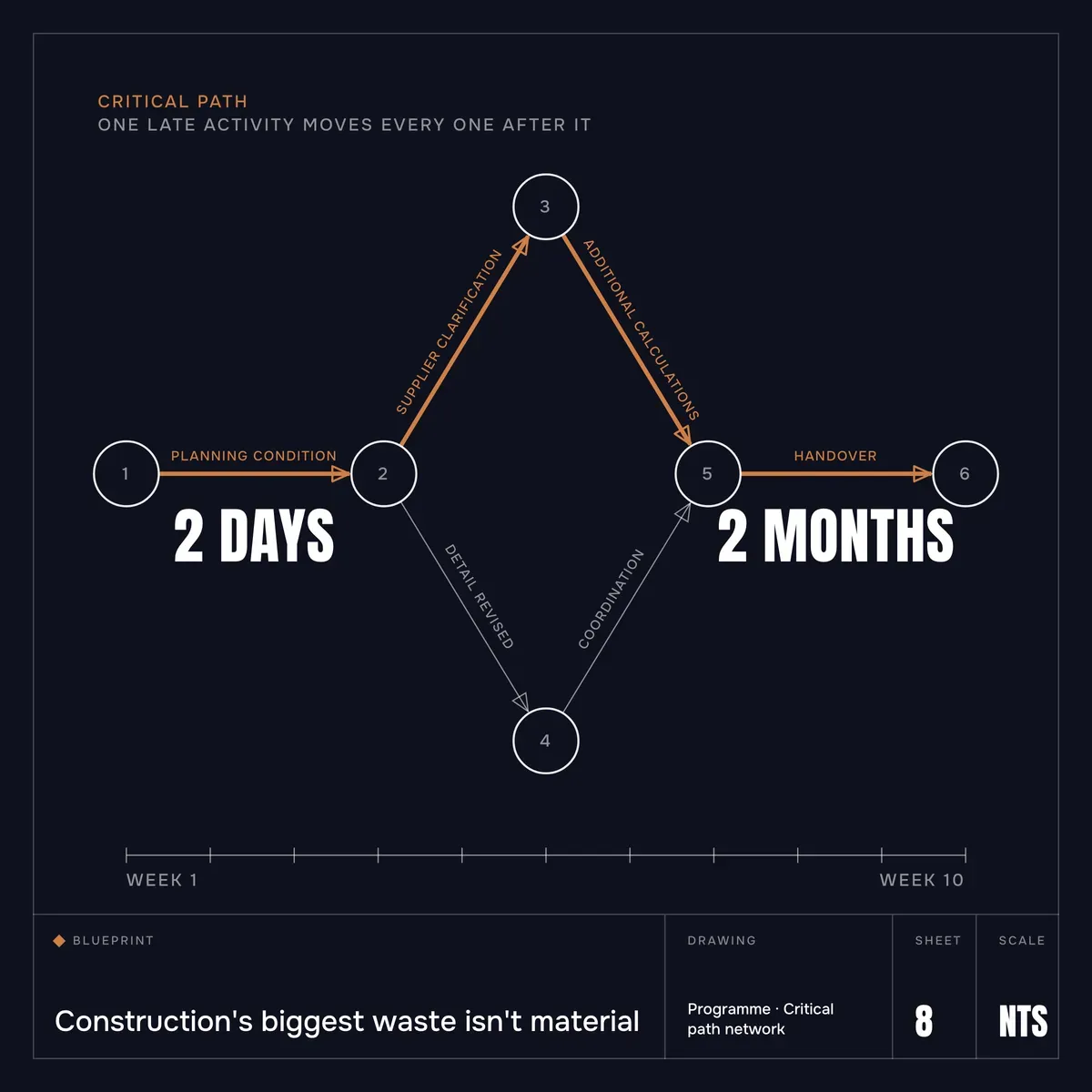
A planning condition takes longer than expected.
A supplier requests clarification.
An architect revises a detail after coordination meetings reveal a conflict.
An engineer needs additional calculations before approving a connection.
Each event appears manageable on its own.
The problem is that construction is one of the world’s most interconnected industries. Every activity depends upon another. A delayed drawing affects procurement. Procurement delays installation. Installation influences commissioning. Commissioning postpones handover.
The original delay may have lasted only two days.
Its consequences may continue for two months.
This is why experienced project directors spend so much time discussing issues that appear relatively small. They understand something less experienced teams often discover too late.
Minor delays have a habit of becoming major ones.
Visible vs Invisible Waste
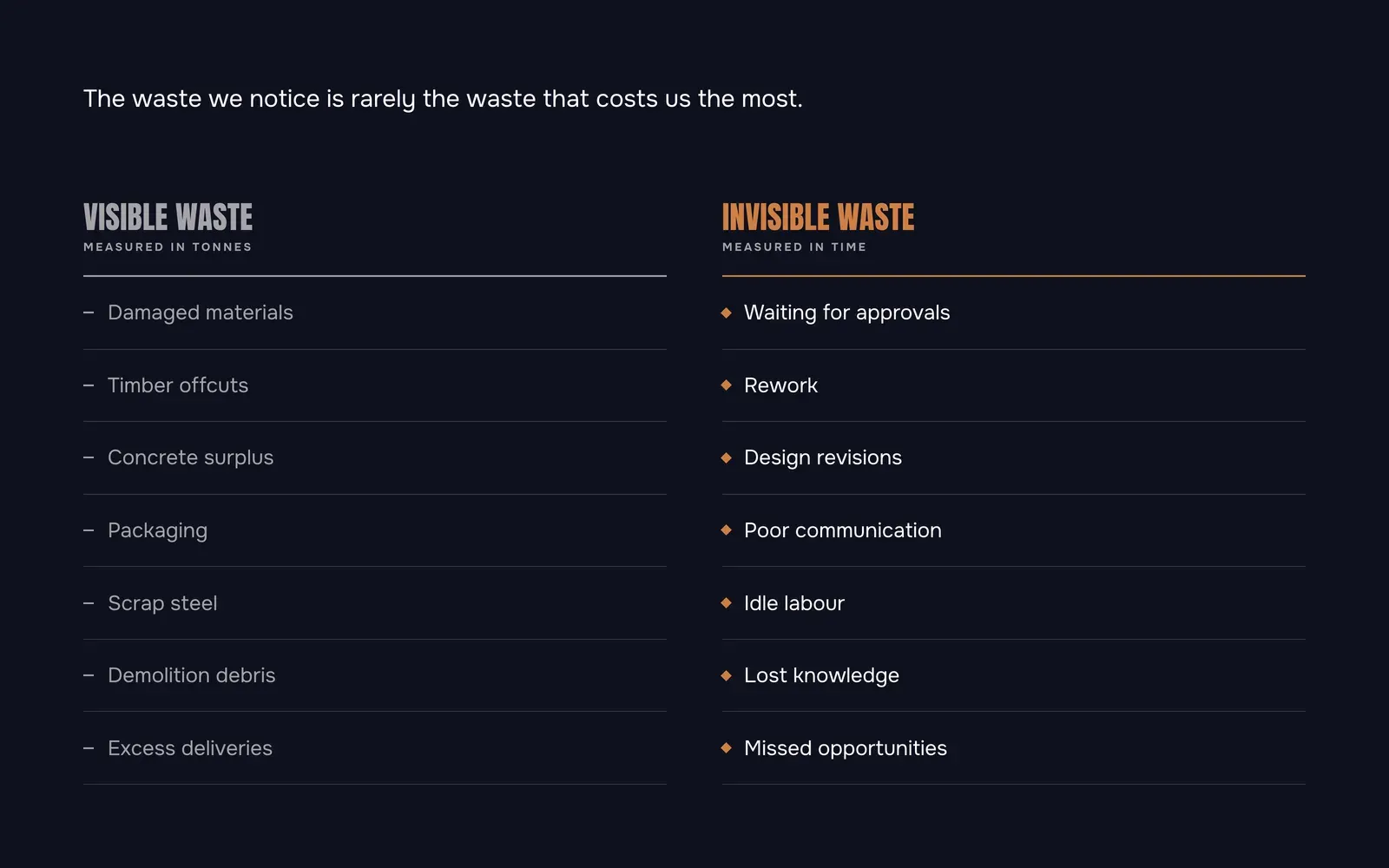
Key Insight: The waste we notice is rarely the waste that costs us the most.
Rework Is the Industry’s Silent Profit Killer
There are few words project teams dislike hearing more than rework.
It represents something every client pays for but nobody wanted.
Unlike unforeseen ground conditions or extreme weather, rework is often preventable. It usually begins with incomplete information, poor coordination, design changes introduced too late or assumptions that were never properly challenged.
The Construction Industry Institute (CII) estimates that rework typically accounts for between 5 and 15 percent of total project costs. On a £200 million development, even the lower end of that range represents millions of pounds spent repeating work instead of delivering new value.
Those figures tell only part of the story.
Every instance of rework creates consequences that spread well beyond the immediate activity. Labour must return to completed areas instead of progressing elsewhere. Plant remains on hire for longer than planned. Follow-on trades are delayed. Commercial teams spend time negotiating responsibility instead of managing future risk.
Perhaps the greatest cost, however, is confidence.
Projects thrive when people believe the programme is achievable and decisions are being made effectively. Repeated rework undermines that confidence. Teams become increasingly cautious. Relationships deteriorate. Collaboration gives way to contract interpretation.
The financial impact appears in the final account.
The cultural impact is felt every day on site.
Construction Already Has the Knowledge It Needs
Spend enough time on major projects and one observation becomes impossible to ignore.
The person who first recognises a problem is rarely the person with the most senior job title.
Sometimes it is a site engineer who notices that two trades are working from different drawing revisions.
Sometimes it is a quantity surveyor who questions whether a specification change has been reflected in the budget.
Sometimes it is a subcontractor who identifies a practical installation issue months before construction reaches that area.
Construction is full of expertise.
The challenge is ensuring that expertise reaches the people capable of acting upon it.
Google reached a remarkably similar conclusion when it studied more than 180 high-performing teams as part of Project Aristotle. Researchers expected successful teams to be defined by intelligence, experience or senior leadership.
Instead, the strongest predictor of performance was psychological safety—the confidence that people could raise concerns, challenge assumptions and admit uncertainty without fear of being ignored or criticised.
Construction projects operate under different conditions, but the lesson is strikingly familiar.
Problems become expensive when people stop talking about them.
Great projects are not built because they encounter fewer problems than everyone else.
They succeed because somebody feels confident enough to speak before those problems become crises.
Lean Construction Changed the Definition of Waste
For generations, waste in construction was measured by what could be seen.
Damaged materials.
Unused equipment.
Overflowing skips.
The objective was simple: reduce what was thrown away.
Then a different way of thinking emerged.
Inspired by the Toyota Production System, Lean Construction challenged one of the industry’s oldest assumptions. Waste was no longer defined as something that ended up in landfill. Instead, it became anything that failed to create value for the client.
That single idea transformed the conversation.
Waiting became waste.
Unnecessary movement became waste.
Poor communication became waste.
Over-processing became waste.
Rework became waste.
Even activities that had long been accepted as part of everyday project delivery—searching for information, attending unnecessary meetings or waiting for approvals—were recognised as consuming time without improving the finished building.
It was a subtle shift in thinking.
But it fundamentally changed how high-performing projects measured success.
The most productive construction teams were no longer those working the longest hours.
They were the teams creating the greatest value with the least amount of wasted effort.
Where Projects Lose the Most Value
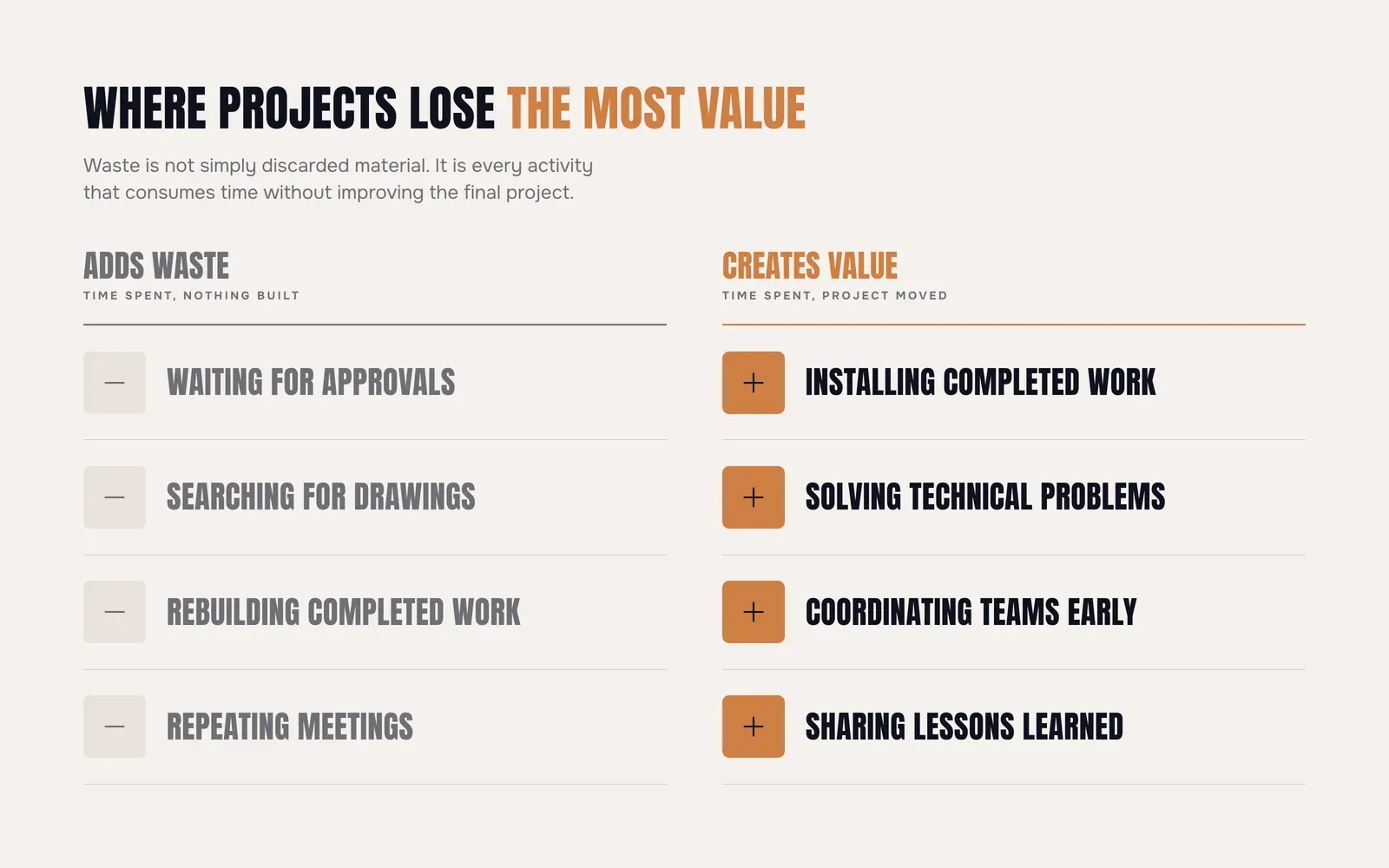
Key Insight: Waste is not simply discarded material. It is every activity that consumes time without improving the final project.
Technology Is Finally Making Invisible Waste Visible
Construction has never suffered from a shortage of information.
Every project generates thousands of drawings, specifications, RFIs, inspection reports, schedules, meeting minutes and photographs. The challenge has never been collecting data.
The challenge has been understanding it quickly enough to make better decisions.
That is where artificial intelligence is beginning to reshape the industry.
Platforms such as Buildots, OpenSpace and Doxel continuously compare site progress against BIM models and project schedules using computer vision and 360-degree imagery. Instead of discovering delays weeks later through programme updates, project teams receive early warnings while there is still time to respond.
Planning is evolving in much the same way. ALICE Technologies uses generative AI to simulate thousands of construction sequences, allowing planners to compare different scenarios before work begins. nPlan analyses millions of historical programme records to identify where delays are statistically most likely to occur, helping project teams focus attention on the greatest risks rather than relying solely on experience.
Commercial management is changing too. AI-powered estimating platforms such as Togal.AI and Kreo automate quantity take-offs directly from drawings, allowing quantity surveyors to spend less time measuring and more time analysing commercial risk. Meanwhile, Procore AI, Microsoft 365 Copilot, Google Gemini and ChatGPT Enterprise help teams search specifications, summarise meetings and retrieve critical information in seconds rather than hours.
None of these technologies lays foundations, erects steel or pours concrete.
What they do is reduce one of construction’s greatest sources of waste.
The time spent looking for answers.
Artificial intelligence does not eliminate the need for experienced professionals.
It allows those professionals to spend more time solving problems instead of searching for them.
Turning Waste Into Value
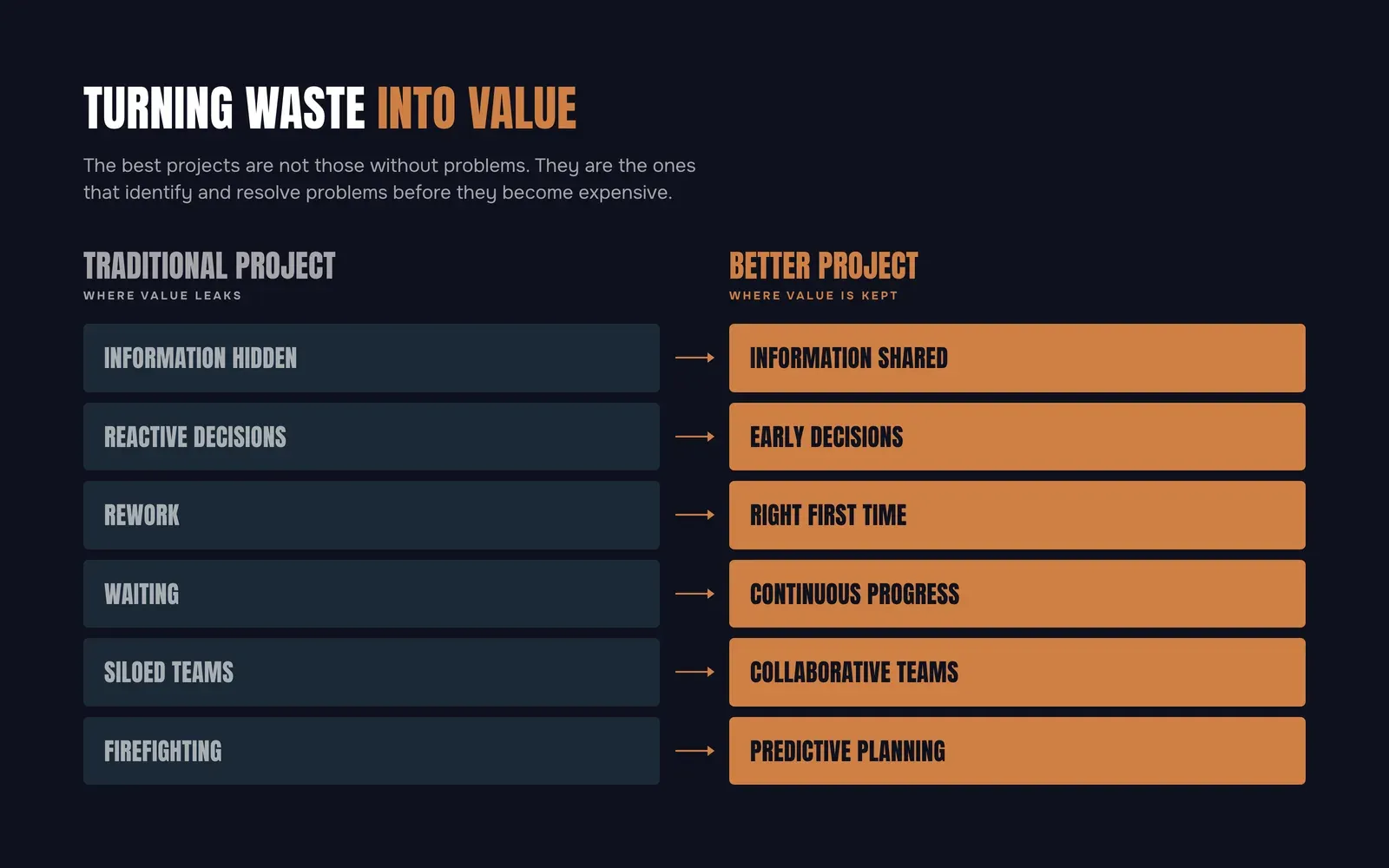
Key Insight: The best projects are not those without problems. They are the ones that identify and resolve problems before they become expensive.
The Industry’s Next Productivity Revolution
Construction has always been remarkably good at solving engineering challenges.
It has delivered bridges that span kilometres, skyscrapers that redefine city skylines and infrastructure that supports millions of people every day.
Yet despite extraordinary technical progress, productivity across much of the global construction industry has improved far more slowly than many other sectors.
The reason is surprisingly simple.
The industry’s biggest constraint is no longer engineering capability.
It is the ability to move information, decisions and knowledge efficiently between people.
Every delayed approval extends a programme.
Every unanswered question slows progress.
Every lesson forgotten forces another team to solve the same problem again.
Every hour a highly skilled professional spends searching through emails, drawings or meeting notes is an hour not spent creating value.
These losses are rarely measured.
But together, they define the success or failure of almost every project.
The next generation of construction leaders will not simply ask how many tonnes of waste left the site.
They will ask a far more valuable question.
How much of our people’s time created value today?
That shift in thinking could become the industry’s greatest productivity breakthrough.
Because materials can usually be replaced.
Money can often be recovered.
Programmes can sometimes be accelerated.
But time, knowledge and opportunity are resources that disappear the moment they are wasted.
Construction has spent decades improving how it manages materials.
The next decade may be defined by how well it manages everything else.
Because the construction industry’s greatest waste has never been concrete, timber or steel.
It has always been the value that was never created.
Sources
- Construction Industry Institute (CII) – Research on Front-End Planning, Rework and Project Alignment
https://www.construction-institute.org 2. Lean Construction Institute – Lean Construction Principles and the Elimination of Waste
https://www.leanconstruction.org 3. Project Management Institute (PMI) – Pulse of the Profession
https://www.pmi.org 4. Bent Flyvbjerg & Dan Gardner – How Big Things Get Done (Penguin Random House, 2023) 5. McKinsey & Company – The Next Normal in Construction and Imagining Construction’s Digital Future
https://www.mckinsey.com 6. Google re:Work – Project Aristotle: Understanding Team Effectiveness
https://rework.withgoogle.com 7. World Green Building Council – Bringing Embodied Carbon Upfront
https://worldgbc.org 8. Autodesk – State of Design & Make Report
https://www.autodesk.com 9. Buildots – Construction Performance and Progress Monitoring
https://buildots.com 10. OpenSpace – Reality Capture for Construction Projects
https://www.openspace.ai 11. Doxel – AI-Powered Construction Progress Tracking
https://www.doxel.ai 12. ALICE Technologies – Generative Construction Scheduling
https://www.alicetechnologies.com 13. nPlan – Predictive Schedule Analytics
https://www.nplan.io 14. International Energy Agency (IEA) – Buildings and Construction Global Status Report
https://www.iea.org 15. Toyota Motor Corporation – Toyota Production System