AI Is Already Transforming the Way Projects Are Delivered
From site monitoring to scheduling, estimating and safety, AI is quietly solving specific problems across the construction lifecycle.
Artificial intelligence is often discussed as though it were a technology waiting to arrive. In reality, it is already embedded in many of the world’s largest construction and infrastructure projects. The difference is that most successful applications are quietly solving specific problems rather than attempting to revolutionise the entire industry overnight.
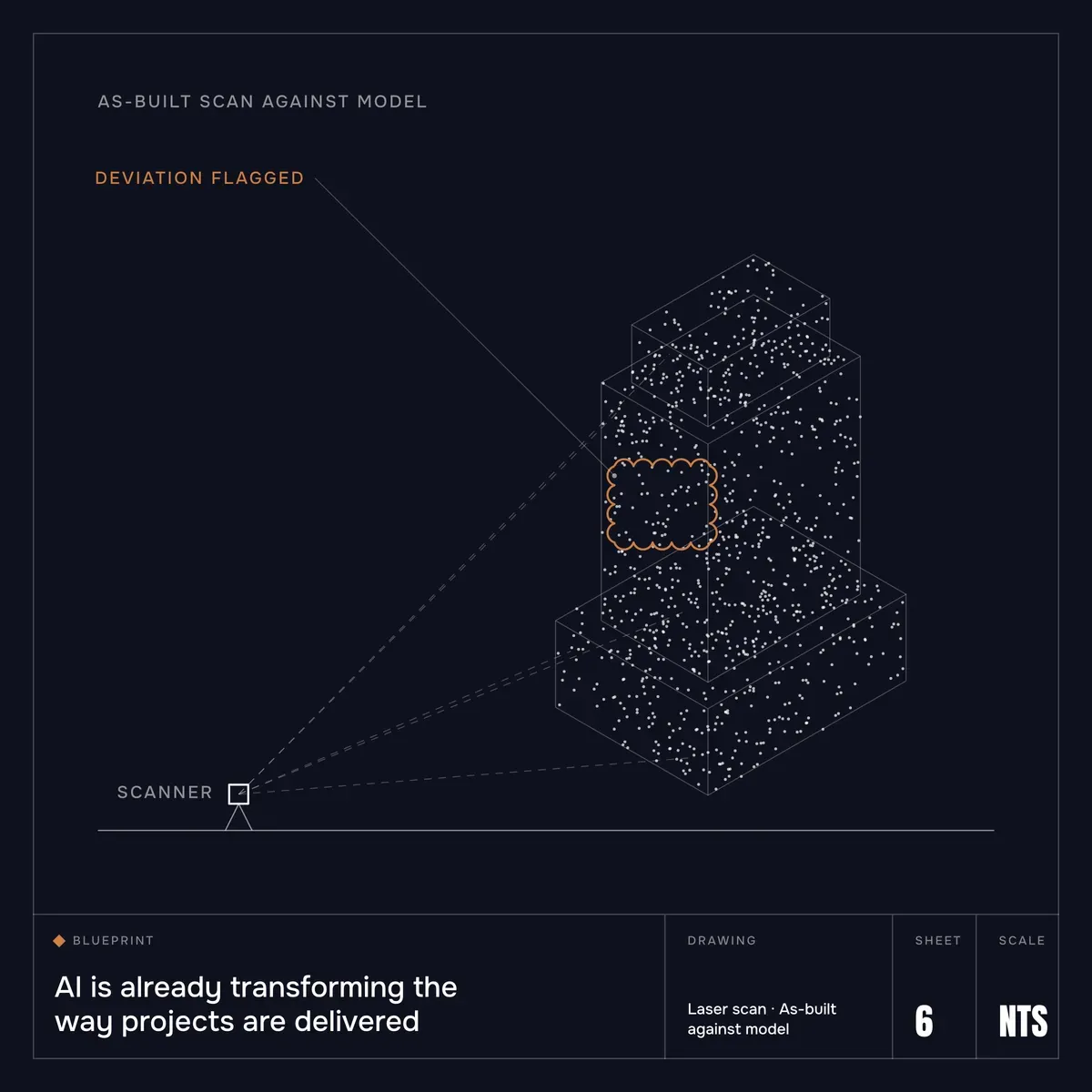
On site, platforms such as Buildots, OpenSpace and Doxel use computer vision and 360-degree imagery to compare actual construction progress against BIM models and project schedules. Rather than relying solely on manual site inspections, these systems continuously identify incomplete work, highlight deviations from the programme and alert project teams to emerging delays before they become critical.
Planning has also become increasingly data-driven. ALICE Technologies uses generative AI to simulate thousands of possible construction sequences, helping planners identify the safest and most efficient programme before work begins. nPlan takes a different approach, analysing millions of historical programme records to predict where future delays are most likely to occur. Meanwhile, Oracle Primavera Cloud and Microsoft Project with Copilot are introducing predictive scheduling features that help teams understand the likely impact of changes before they affect the critical path.
The design process is undergoing a similar transformation. Autodesk Forma enables architects and planners to evaluate multiple site layouts within minutes, considering daylight, wind conditions, energy performance and planning constraints long before detailed design begins. Bentley iTwin creates intelligent digital twins that allow owners and engineers to monitor infrastructure throughout its lifecycle, while Autodesk Construction Cloud increasingly uses AI to review documents, identify risks and streamline the management of RFIs and submittals.
Commercial teams are also seeing significant gains. Traditional quantity take-offs can consume days of manual effort, particularly on large projects. AI-powered platforms such as Togal.AI and Kreo automate much of this process by extracting quantities directly from drawings, allowing quantity surveyors to spend less time measuring and more time analysing costs and managing commercial risk.
Safety is another area where artificial intelligence is proving its value. Platforms including Newmetrix, HammerTech and Everguard.ai analyse photographs, video feeds and site observations to identify unsafe behaviours, missing personal protective equipment and emerging trends that might otherwise go unnoticed. Rather than replacing safety professionals, these systems provide another layer of visibility across increasingly complex construction sites.
Perhaps the most overlooked application of AI is information management. Every project generates thousands of drawings, specifications, meeting minutes, emails and technical documents. Tools such as Procore AI, Bluebeam Max, Microsoft 365 Copilot, Google Gemini and ChatGPT Enterprise help project teams search, summarise and interpret this information in seconds. Instead of spending hours locating a specification or reviewing lengthy meeting notes, teams can focus on making informed decisions while the software handles much of the administrative workload.
None of these technologies pours concrete, installs steel or manages subcontractors.
What they do is far more subtle—and potentially far more valuable.
They help project teams recognise problems earlier, understand them faster and make better decisions before small issues become expensive delays.
AI Across the Construction Lifecycle
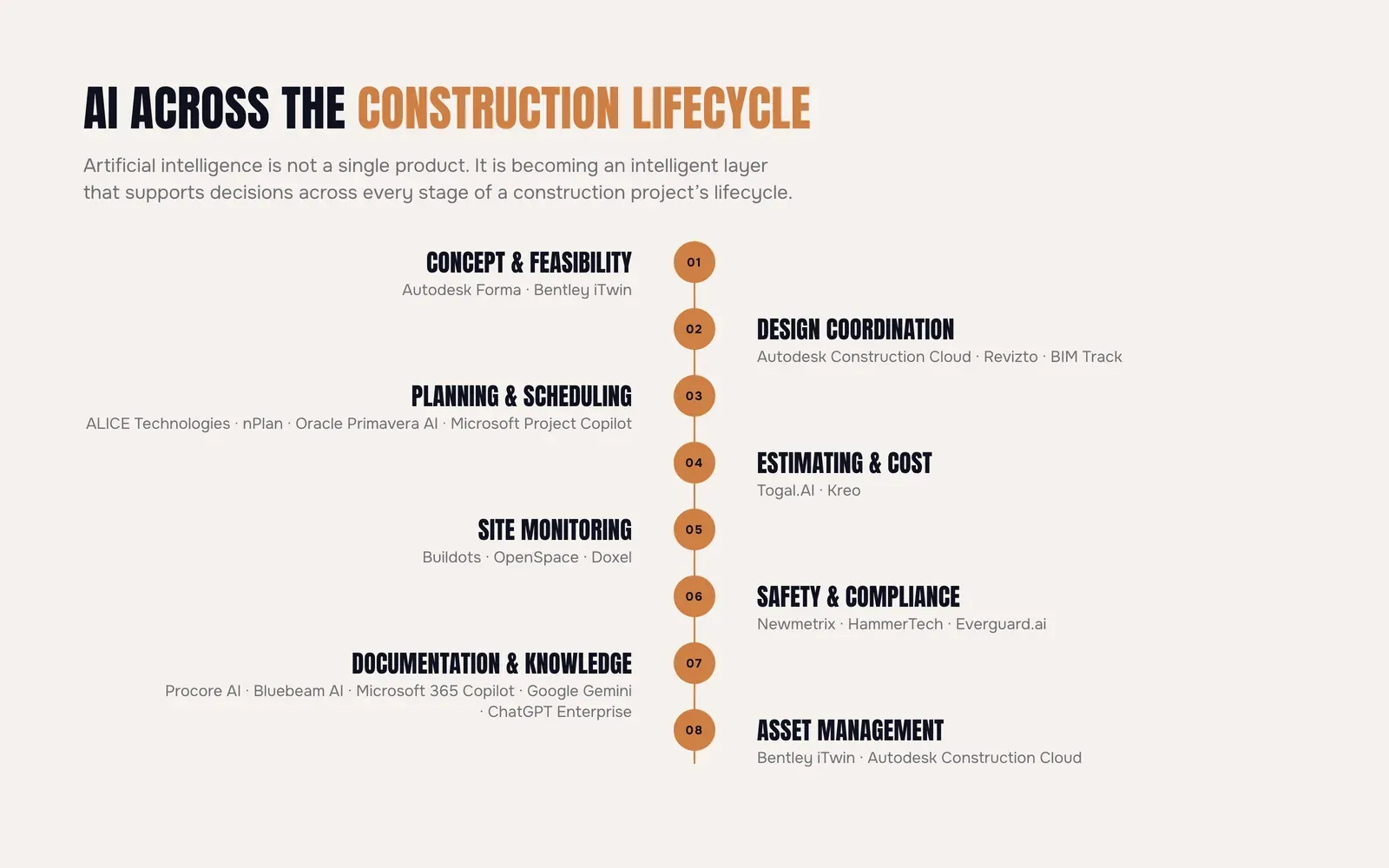
Key Insight: Artificial intelligence is not a single product. It is becoming an intelligent layer that supports decisions across every stage of a construction project’s lifecycle.
Construction has always embraced innovation, from mechanised equipment and CAD to BIM, digital twins and modular construction. Artificial intelligence is simply the next chapter in that evolution. Like every major technological shift before it, its true value will not be measured by how impressive the technology appears, but by the problems it helps solve.
The companies that gain the greatest advantage will not necessarily be those with the largest AI budgets or the newest software. They will be the organisations that combine intelligent technology with experienced professionals, clear processes and a culture that encourages better decisions. AI can analyse millions of data points, identify hidden patterns and forecast risks long before they become visible to the human eye. What it cannot do is replace leadership, judgement, accountability or trust.
The construction industry has never suffered from a shortage of data. It has suffered from a shortage of timely insight.
That is where artificial intelligence has the potential to make its greatest contribution.
Imagine a project where planners receive early warnings before schedules begin to slip. Where quantity surveyors identify commercial risks before they become claims. Where site managers know exactly which activities are falling behind before they affect the critical path. Where project directors spend less time searching for information and more time making informed decisions.
That future is no longer theoretical. It is already beginning to emerge across projects around the world.
Yet technology alone will never deliver successful buildings.
Successful projects are still built on collaboration, communication and the experience of the people responsible for turning complex ideas into physical reality. AI should not be viewed as a replacement for those professionals, but as a tool that amplifies their expertise, allowing them to anticipate problems earlier, respond faster and make better decisions with greater confidence.
The most successful construction companies of the next decade will not be those that simply adopt artificial intelligence.
They will be the ones that learn how to work intelligently alongside it.
Sources
- McKinsey & Company – Artificial Intelligence: Construction Technology and the Future of Capital Projects
https://www.mckinsey.com 2. Autodesk – State of Design & Make Report
https://www.autodesk.com 3. World Economic Forum – Shaping the Future of Construction
https://www.weforum.org 4. Deloitte – AI in Engineering and Construction
https://www.deloitte.com 5. Project Management Institute (PMI) – Pulse of the Profession
https://www.pmi.org 6. Bent Flyvbjerg & Dan Gardner – How Big Things Get Done (2023) 7. Stanford Center for Integrated Facility Engineering (CIFE) – Research on construction productivity and digital innovation
https://cife.stanford.edu 8. Buildots – Construction Progress Monitoring Case Studies
https://buildots.com 9. ALICE Technologies – AI Construction Scheduling Research
https://www.alicetechnologies.com 10. Bentley Systems – Digital Twins and Infrastructure Intelligence